How Mutual TLS Works: The Two-Way Handshake Explained

When two systems exchange patient health records over a network, both sides need to prove their identity, not just one. That's exactly how mutual TLS works: instead of only the server presenting a certificate (like standard HTTPS), the client authenticates itself too, creating a two-way cryptographic handshake before any data moves. It's a fundamental security mechanism for machine-to-machine communication, and it's especially critical in healthcare, where unauthorized access to EHR data isn't just a security incident, it's a compliance violation.
At SoFaaS, we build managed infrastructure that connects healthcare applications to EHR systems like Epic and Cerner using the SMART on FHIR standard. Enterprise-grade transport security is non-negotiable in that work. Mutual TLS (mTLS) is one of the protocols that makes it possible to verify both ends of a connection, your application and the EHR, before any protected health information is transmitted.
This article breaks down the full mTLS handshake step by step, explains how it differs from standard one-way TLS, and covers where it fits into real-world architectures. Whether you're a developer building healthcare integrations or a technical leader evaluating your security stack, you'll walk away with a clear understanding of the protocol and why it matters for securing sensitive data in transit.
Why mutual TLS matters for API security in healthcare
Healthcare APIs carry some of the most sensitive data in any industry. When your application calls an EHR endpoint to retrieve patient records, a stolen or forged credential is all an attacker needs to intercept that exchange. Standard HTTPS protects the channel, but it only verifies the server's identity, leaving the client side open to impersonation. Understanding how mutual TLS works makes clear why healthcare environments need a stronger model: one where both the application and the server prove who they are before the connection opens.
The compliance pressure behind stronger transport security
HIPAA's Security Rule requires covered entities and their business associates to implement technical safeguards that protect electronic protected health information (ePHI) in transit. The regulation doesn't prescribe mTLS by name, but it does demand access controls and transmission security that hold up under audit. Mutual certificate authentication satisfies both requirements in a single mechanism, because it ties every connection to a verified identity, not just a password or token that can be phished or leaked.
When a certificate is compromised, you revoke it at the certificate authority level. When a password is compromised, you often don't know until the damage is done.
How mTLS closes gaps that tokens alone can't
OAuth 2.0 and bearer tokens are the dominant authorization model for SMART on FHIR APIs, and they work well for user-facing flows. The problem is that bearer tokens travel over HTTP headers and can be replayed by anyone who intercepts them, even briefly. mTLS binds the token to the specific client certificate presented during the handshake, a pattern formalized in RFC 8705. That binding means a stolen token is useless without the corresponding private key, which never leaves the client's secure storage.
For machine-to-machine API calls between healthcare systems, this combination of transport-level identity and token binding is the architecture that actually holds. Your application gets mutual authentication at the TLS layer plus scoped authorization at the application layer, and attackers get neither without full access to the client's private key infrastructure.
What you need before enabling mutual TLS
Before you implement mTLS, you need to assemble the right infrastructure. Understanding how mutual TLS works in practice means recognizing that the handshake depends on certificate infrastructure and key management being in place before a single connection is attempted. Skipping this groundwork leads to broken integrations and audit failures.
A certificate authority and signed certificates
You need a Certificate Authority (CA) that both the client and server trust. In healthcare environments, this is typically an internal enterprise CA or a managed PKI service. Your CA issues signed certificates to both sides: one for your application (the client) and one for the EHR endpoint (the server). Without signed certificates from a mutually trusted CA, the handshake will fail before any data transfers.

A self-signed certificate works in development, but it should never reach a production environment that handles patient data.
Secure private key storage
The client certificate is only as strong as the security around its private key. Store private keys in a hardware security module (HSM) or a secrets management service. If the private key is exposed, an attacker can impersonate your application at the transport layer, bypassing every other security control in your stack. Plan for this from the start:
- Hardware Security Modules (HSMs) for key isolation
- Secrets management platforms with strict access controls
- Certificate rotation policies to limit your exposure window
How the mutual TLS handshake works step by step
Understanding how mutual TLS works in sequence helps you diagnose failures and design integrations correctly. Unlike standard TLS, which only authenticates the server, mTLS runs a bidirectional verification before the connection is fully established. Each step builds on the previous one, so a misconfiguration at any point terminates the connection immediately.
The sequence from ClientHello to verified connection
Your client opens the handshake by sending a ClientHello message, advertising supported cipher suites and TLS versions. The server responds with a ServerHello, selects the cipher suite, and presents its own certificate. Your client then verifies the server's certificate against the mutually trusted CA.
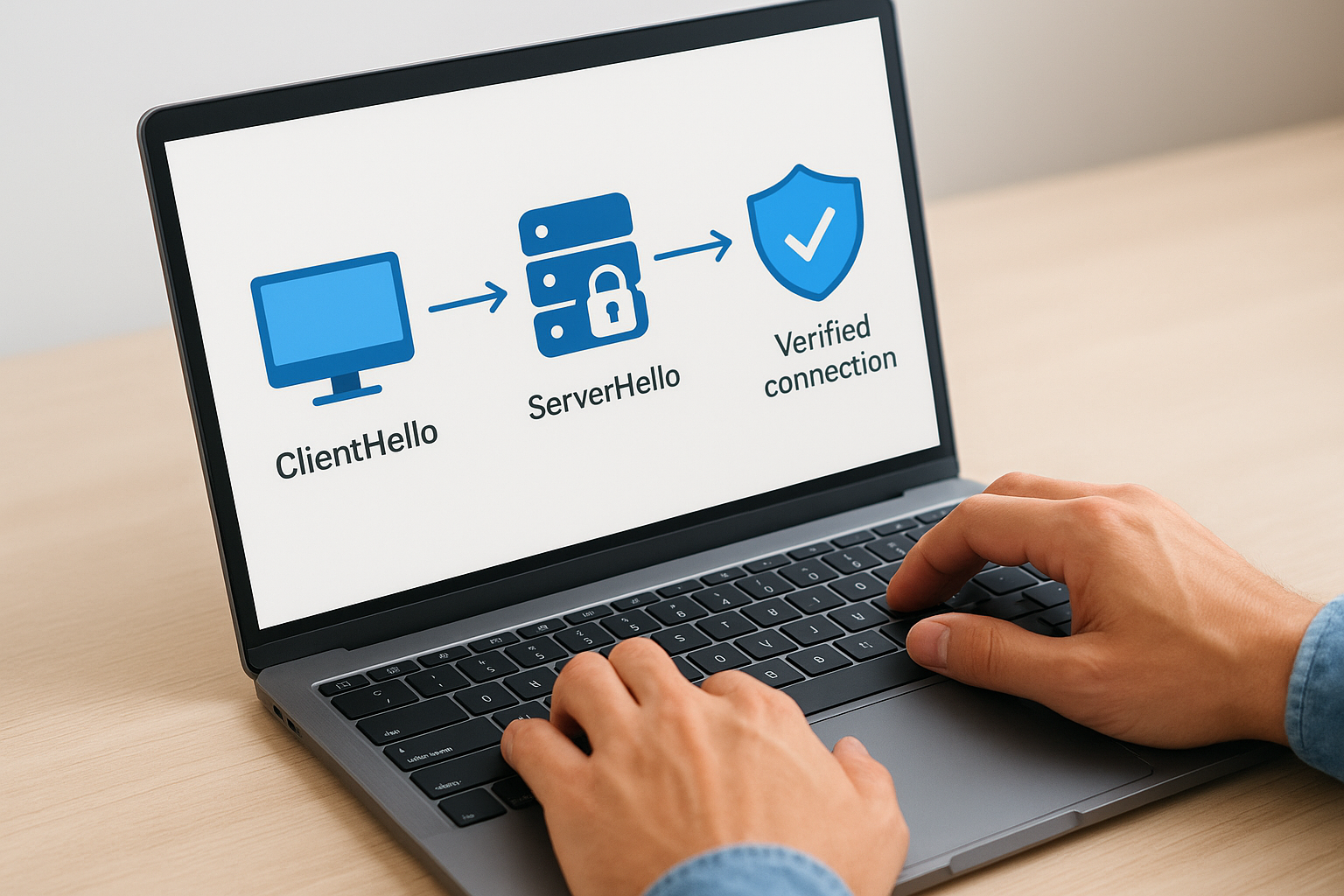
This is where mTLS diverges from standard TLS: the server sends a CertificateRequest, requiring your client to prove its identity too.
Next, your client sends its own certificate, and the server validates it against the same trusted CA. Once both parties pass verification, they exchange keying material and derive a shared session key. From that point forward, all data is encrypted and bound to both verified identities.
What happens if verification fails
If either certificate is invalid, expired, or signed by an untrusted CA, the handshake terminates immediately with an alert. No application data moves. Your connection logs will show a specific alert code, such as certificate_unknown or bad_certificate, pointing you directly to the source of the failure.
Mutual TLS vs regular TLS and OAuth
Regular TLS only authenticates the server. Your browser connects to a website, the server presents its certificate, your client verifies it, and the encrypted channel opens. Your identity as a client is never verified at the transport layer. That works fine for public websites, but it's insufficient when two systems need to exchange sensitive health records and both sides need to prove who they are.
Where OAuth fits in the picture
OAuth 2.0 handles authorization, not transport-level authentication. It answers "what is this client allowed to do?" rather than "is this client actually who it claims to be?" Bearer tokens provide scoped access to API resources, but they travel as strings in HTTP headers that any interceptor can capture and reuse. Understanding how mutual TLS works alongside OAuth clarifies why neither replaces the other.
| Layer | Mechanism | What it verifies |
|---|---|---|
| Transport | mTLS | Client and server identity |
| Authorization | OAuth 2.0 | Permitted actions and scopes |
mTLS and OAuth are complementary, not competing. You need both to secure a healthcare API end to end.
RFC 8705 formalizes the combination by binding an OAuth token to the client certificate used during the mTLS handshake. A stolen token without the matching private key becomes worthless, giving your integration two independent layers of protection against credential theft and replay attacks.
Operational best practices and troubleshooting
Running mTLS in production requires more than a successful initial handshake. Understanding how mutual TLS works day-to-day means treating certificate lifecycle management, rotation schedules, and failure diagnostics as ongoing operational responsibilities, not one-time setup tasks. A single expired certificate can terminate every API connection your application depends on, with no warning to the end user.
Certificate rotation and expiration management
Expired certificates are the most common cause of mTLS failures in production healthcare environments. Set up automated alerts at least 30 days before any certificate reaches its expiration date, and establish a rotation process that replaces certificates without dropping active connections. Your CA should support certificate revocation lists (CRLs) or OCSP so you can invalidate compromised certificates immediately, without waiting for their natural expiration.
Treat certificate expiration the same way you treat a password reset policy: schedule it, automate it, and never let it slip.
Diagnosing handshake failures
When a connection fails during the mTLS handshake, your TLS alert codes tell you exactly where the process broke down. Common codes include certificate_unknown when the server doesn't recognize your client certificate, and handshake_failure when cipher suite negotiation collapses. Work through this checklist before escalating:
- Verify both certificates are signed by the same trusted CA
- Confirm the client certificate has not expired or been revoked
- Check that cipher suites on both ends overlap
- Validate that the private key matches the public key in the certificate

Next steps
You now have a complete picture of how mutual TLS works: the bidirectional certificate handshake, the infrastructure it requires, how it pairs with OAuth to form a layered security model, and how to keep it running reliably in production. That foundation matters because every healthcare API connection you build rests on transport-level trust being established correctly before any patient data moves.
The complexity of managing certificates, key storage, and FHIR-compliant API security at scale is exactly the kind of overhead that slows healthcare integrations down. If you're building applications that connect to EHR systems like Epic or Cerner, you don't need to assemble that infrastructure from scratch. SoFaaS handles HIPAA-compliant transport security, SMART on FHIR authorization, and EHR connectivity in a managed platform built specifically for healthcare. Launch your SMART on FHIR app in days and spend your time building features, not maintaining security plumbing.
The Future of Patient Logistics
Exploring the future of all things related to patient logistics, technology and how AI is going to re-shape the way we deliver care.
Thank you! Your submission has been received!
Oops! Something went wrong while submitting the form.