Revenue Cycle Management: What It Is and How It Works

If you've ever asked what is revenue cycle management, you're not alone. Every healthcare organization, from a small home health agency to a hospital system, depends on this process to get paid for the care they deliver. Without it, claims get denied, cash flow stalls, and staff spend hours chasing payments instead of serving patients.
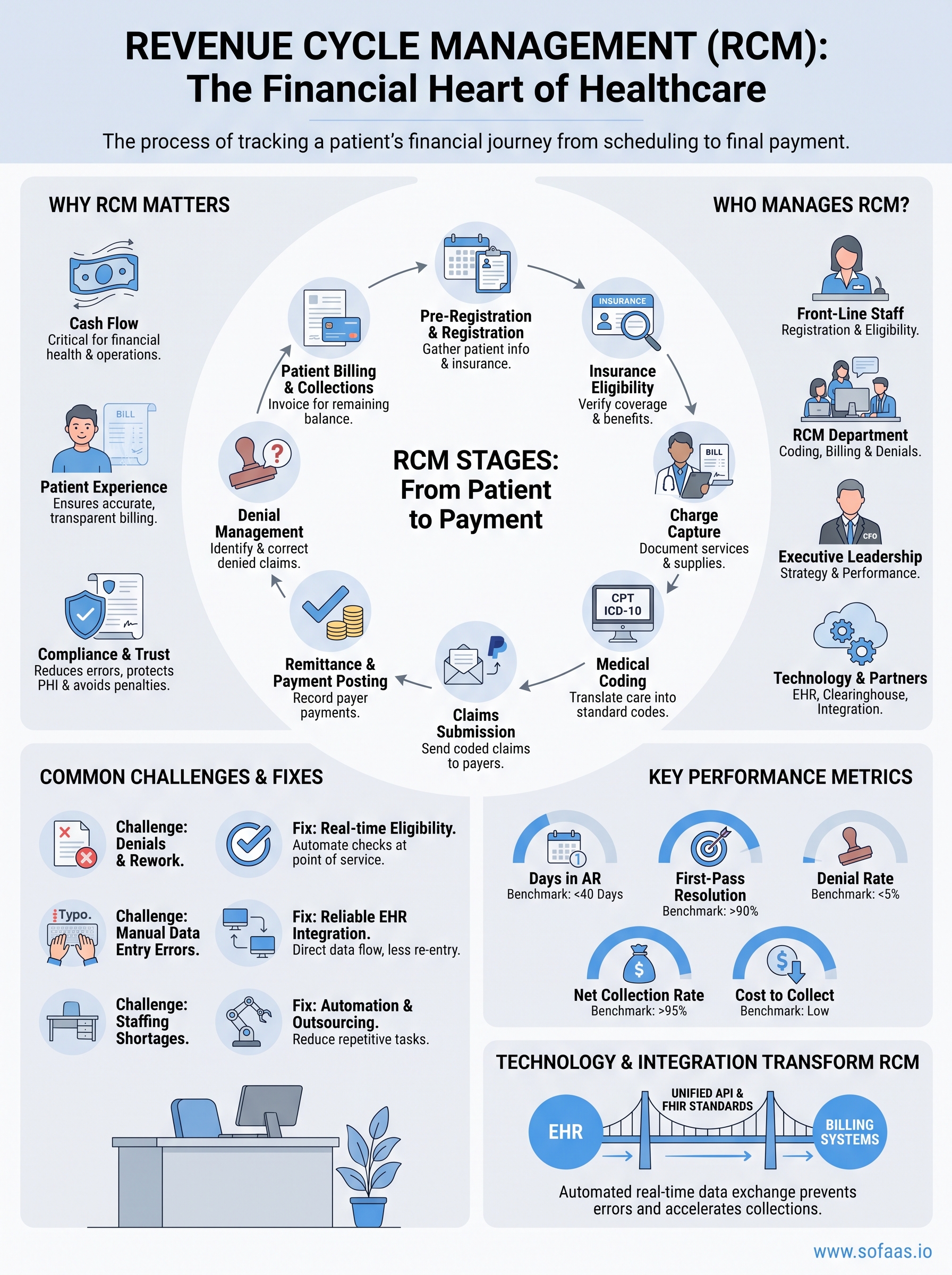
Revenue cycle management, or RCM, is the financial process that tracks a patient's account from the moment they schedule an appointment until the final payment is collected. It covers patient registration, insurance verification, coding, claims submission, and payment posting. Done well, RCM shortens the time between service and payment while reducing costly billing errors.
This article breaks down each stage of the revenue cycle so you understand exactly how money moves through a healthcare organization. We'll walk through the front-end and back-end steps, explain where most practices lose revenue, and show how accurate, real-time patient data, the kind that comes from a reliable EHR integration, keeps the entire billing process running smoothly.
Why revenue cycle management matters for healthcare organizations
Money is the obvious reason revenue cycle management exists, but the stakes run deeper than the bottom line. A hospital, clinic, or home health agency can deliver excellent clinical care and still struggle to survive if its billing and collections process breaks down. Every denied claim, every unverified insurance eligibility check, and every coding mistake delays the cash an organization needs to pay staff, restock supplies, and keep the lights on. That's why so many administrators start their research by asking what is revenue cycle management in the first place: they've felt the pain of a broken one firsthand.
The direct financial impact on cash flow
Cash flow problems in healthcare rarely come from a single dramatic failure. They build up from small, repeated gaps across the revenue cycle, an eligibility check skipped here, a claim submitted with the wrong modifier there. Industry research consistently shows that a meaningful share of claims get denied on first submission, and reworking a denied claim costs far more in staff time than getting it right the first time. Organizations that let days in accounts receivable stretch out often end up carrying bad debt they never recover, which forces cuts elsewhere in the organization, sometimes in patient-facing services.
An organization that can't reliably collect for the care it delivers eventually can't keep delivering that care.
The connection to patient trust and experience
Patients notice when billing goes wrong. A surprise bill, a claim that bounces back and forth between the practice and the insurer, or a statement that doesn't match what the patient was told at check-in all chip away at trust. The federal No Surprises Act, enforced in part by the Centers for Medicare & Medicaid Services, raised the bar for billing transparency and put real financial penalties behind it. A well-run healthcare revenue cycle management process protects patients from confusing or inaccurate bills, and that transparency has become a competitive differentiator, not just a compliance checkbox.
Compliance and regulatory exposure
Revenue cycle work touches some of the most tightly regulated data in existence: protected health information, insurance details, and payment records. Coding errors don't just cost money in denied claims, they can trigger payer audits or, in serious cases, allegations of fraudulent billing. Getting coding accuracy and documentation right the first time protects the organization from that exposure. It also depends on strong HIPAA compliance across every system that touches patient financial data, from the scheduling software at check-in to the clearinghouse that submits claims to payers.
RCM as an operational multiplier, not just a back-office function
A healthy revenue cycle frees up staff to do higher-value work instead of chasing payments and correcting avoidable errors. Consider what changes when the front end of the cycle runs smoothly:
| Revenue cycle condition | Effect on staff | Effect on patients |
|---|---|---|
| Accurate eligibility checks at scheduling | Fewer denied claims to rework | Clear expectations about coverage and cost |
| Real-time insurance and demographic data | Less time spent on manual data entry | Fewer requests to "come back with more information" |
| Clean claims submitted the first time | Faster reimbursement, lower AR days | Fewer confusing or delayed statements |
| Integrated EHR and billing data | Reduced coding errors and rework | More accurate, timely billing |
That last row matters more than most organizations realize. A lot of revenue cycle friction traces back to bad or delayed data flowing between the electronic health record and the billing system. When registration staff enter patient information manually because the systems don't talk to each other, errors creep in, and those errors surface weeks later as denied claims. This is exactly the gap that a reliable EHR integration closes, and it's why platforms like SoFaaS exist: connecting billing and clinical systems to the EHR through a standardized, secure integration removes one of the biggest sources of revenue cycle breakdown before it ever reaches the claims stage. Organizations that treat data integration as part of their revenue cycle strategy, not a separate IT project, tend to see denial rates drop and collections speed up within a few billing cycles.
How revenue cycle management works, step by step
The revenue cycle runs in a predictable sequence, even though the terminology varies from one health system to the next. Breaking it into stages makes it easier to see where things typically go wrong, because most denials trace back to a handful of failure points rather than random bad luck. The full cycle usually looks like this:

- Pre-registration - scheduling the appointment and collecting basic demographic and insurance information in advance.
- Registration - confirming and updating patient details at check-in, including identity verification.
- Insurance eligibility verification - checking active coverage, copays, deductibles, and any prior authorization requirements before service is rendered.
- Charge capture - documenting every billable service, supply, and procedure performed during the visit.
- Medical coding - translating clinical documentation into standardized CPT, ICD-10, and HCPCS codes.
- Claims submission - sending the coded claim to the payer, typically through a clearinghouse that scrubs it for errors first.
- Remittance and payment posting - recording what the payer actually paid against what was billed.
- Denial management - identifying, correcting, and resubmitting claims the payer rejected or underpaid.
- Patient billing and collections - invoicing the patient for any remaining balance and collecting it.
Front-end steps set up everything downstream
Registration and eligibility verification happen before a claim is even generated, but they determine whether that claim survives contact with the payer. If a staff member mistypes a policy number or misses an inactive insurance plan at check-in, that error rides along through coding and claims submission until the payer kicks it back weeks later. Fixing it at the point of registration takes thirty seconds. Fixing it after a denial takes a phone call, a corrected claim, and another two or three weeks of waiting.
Most revenue cycle failures start at the front desk, not at the billing office.
Middle steps turn care into a claim
Charge capture and coding convert what actually happened during a visit into the language payers require. A missed charge means lost revenue that no one will ever notice until a chart audit catches it, and a mismatched code between the documentation and the claim is one of the most common claim denial reasons payers cite. Coders need clean, complete documentation to do this well, which is another reason accurate data at the point of care matters so much.
Back-end steps close the loop on payment
Once a claim leaves the building, the back end takes over: submission, remittance, denial management, and patient collections. Speed matters here as much as accuracy, since every extra day in this phase adds to accounts receivable and delays cash the organization has already earned. Systems that pull patient and encounter data directly from the EHR, rather than relying on manual re-entry between front-end and back-end steps, tend to move through this whole sequence with far fewer errors and far less rework.
Who manages the revenue cycle in a healthcare organization
No single person runs revenue cycle management. It's a relay race across departments, and a fumble anywhere in the chain slows down payment for everyone downstream. Understanding who owns each stage helps you see why RCM breakdowns are so often blamed on "billing" when the real problem started somewhere else entirely, sometimes weeks earlier and several departments away.

Front-line staff start the cycle before anyone notices
Registration clerks, schedulers, and medical assistants touch the revenue cycle first, even though most of them would never describe their job that way. They collect insurance information and demographic data, verify identity, and confirm coverage before a provider ever sees the patient. Clinical staff, physicians, nurses, and medical assistants, then generate the documentation that coders depend on to bill accurately. If a provider's note doesn't support the level of service billed, no amount of downstream effort fixes that gap.
The revenue cycle department carries the technical work
Behind the scenes, a dedicated team handles the specialized parts of the process:
| Role | Primary responsibility |
|---|---|
| Medical coder | Translates clinical documentation into CPT, ICD-10, and HCPCS codes |
| Billing specialist | Prepares and submits claims, corrects rejected submissions |
| Denial management analyst | Investigates denied claims and manages appeals |
| Patient financial counselor | Explains costs, sets up payment plans, handles collections calls |
| Revenue cycle manager | Oversees the whole department's performance and workflow |
Smaller practices often combine several of these roles into one or two people, while hospital systems run entire departments dedicated to each function. Either way, these are the people who translate clinical care into a payer's language and chase down every dollar the organization is owed.
Executive leadership sets the strategy and holds the budget
Above the day-to-day work, a Chief Financial Officer or, in larger systems, a dedicated Chief Revenue Officer owns the strategy behind the revenue cycle. They set denial rate targets, approve technology investments, and answer to the board when collections lag behind expectations. This is also where the decision to outsource billing, hire additional coders, or invest in EHR integration technology usually gets made, since those choices carry real budget implications.
Revenue cycle management only works when clinical staff, billing teams, and leadership treat it as a shared responsibility, not a back-office problem.
Technology increasingly acts as a member of the team
Many organizations now lean on clearinghouses, billing software, and integration platforms to do work that used to require additional hires. A healthcare revenue cycle management platform can automate eligibility checks, flag coding mismatches before submission, and sync patient data automatically instead of relying on manual re-entry between systems. This doesn't replace the human roles above, it removes the repetitive, error-prone parts of their jobs so coders and billers can spend their time on the claims that actually need judgment, not on chasing down a mistyped policy number.
Common revenue cycle management challenges and how to fix them
Every organization runs into the same handful of problems, no matter how big or small the practice is. Recognizing the pattern is the first step toward fixing it, because most of these issues share a root cause: bad or missing data at the point of care. The fixes below aren't theoretical, they're the adjustments that actually move denial rates and collection speed in the right direction.
Claim denials keep piling up
Denials remain the single biggest drain on revenue cycle management, and the causes are almost always preventable: eligibility that wasn't checked, a missing prior authorization, or a code that doesn't match the documentation. Fixing this starts before the claim exists, with real-time eligibility verification at scheduling and check-in rather than a batch check run the night before. Practices that automate this step routinely cut their first-pass denial rate within a couple of billing cycles.
Every denied claim you prevent is worth more than every denied claim you appeal.
Manual data entry introduces errors nobody catches until it's too late
Front desk staff retyping insurance details, demographics, and visit notes across disconnected systems is still common, and every retype is a chance to introduce a typo that surfaces weeks later as a rejected claim. Handling this well means giving front-end and billing systems a direct line to the EHR instead of a human middleman. That's precisely the gap a reliable EHR integration like SoFaaS closes, pulling verified patient and encounter data straight from the record so billing staff work from the same accurate information clinicians already documented.
Staffing shortages leave claims sitting unworked
Revenue cycle departments across the country report chronic vacancies in coding and billing roles, and unworked claims age into write-offs while short-staffed teams triage whatever's most urgent. Solving this long-term means combining targeted hiring with automation that removes repetitive work, letting fewer staff cover more claims without burning out. Outsourcing select functions, like denial appeals or coding for a specific specialty, also buys time while a team rebuilds capacity.
Fragmented systems create data silos
When scheduling, EHR, billing, and clearinghouse systems don't share data automatically, staff spend hours reconciling records that should already match. This is where a unified API approach pays off, connecting every system that touches patient financial data through one standardized integration instead of a patchwork of point-to-point interfaces.
| Challenge | Root cause | Practical fix |
|---|---|---|
| High claim denial rate | Missed eligibility or authorization checks | Real-time verification before service |
| Data entry errors | Manual re-entry across disconnected systems | Direct EHR integration for registration and billing |
| Slow claims processing | Understaffed or overloaded billing team | Automation plus targeted outsourcing |
| Inconsistent patient data | Siloed scheduling, EHR, and billing systems | Unified API connecting all systems |
Getting ahead of these challenges rarely requires a complete overhaul. Small, targeted fixes at the front end of the cycle, especially around data accuracy, prevent most of the downstream chaos that billing teams otherwise spend their days cleaning up.
Key metrics for measuring revenue cycle performance
You can't manage what you don't measure, and revenue cycle management lives or dies on a handful of numbers that tell you exactly where the process is breaking down. Tracking the right key performance indicators turns vague complaints like "billing feels slow" into specific, fixable problems. Most organizations only need a handful of metrics tracked consistently, not a dozen dashboards nobody reads.

Days in accounts receivable
This metric measures the average number of days it takes to collect payment after a claim goes out the door. A rising days in accounts receivable number almost always points to a bottleneck somewhere in claims submission, payer follow-up, or patient collections. Healthy practices typically keep this under 40 days, while anything past 60 signals real cash flow risk.
First-pass resolution and denial rate
First-pass resolution rate tracks the percentage of claims paid on the first submission, with no rework required. Denial rate is its mirror image, showing how many claims bounce back for correction or appeal. Together these two numbers reveal the true cost of a broken front end, since every denied claim requires staff time that a clean claim never would.
A rising denial rate is rarely a billing problem. It's usually a data problem that started weeks earlier.
Net collection rate
While gross collection rate compares payments to total charges, net collection rate compares actual payments to what the organization was contractually owed after adjustments. This distinction matters because gross rates can look healthy even when an organization is quietly writing off money it was entitled to collect. Most well-run practices target a net collection rate above 95%.
Cost to collect
This figure captures how much it costs, in staff time, software, and outsourced services, to collect each dollar of revenue. Organizations relying on manual data entry and disconnected systems typically see a higher cost to collect than those running automated eligibility checks and integrated billing workflows, because so much of that cost hides in avoidable rework.
| Metric | What it measures | Healthy benchmark |
|---|---|---|
| Days in accounts receivable | Average time to collect after claim submission | Under 40 days |
| First-pass resolution rate | Percentage of claims paid without rework | Above 90% |
| Denial rate | Percentage of claims rejected or denied | Below 5% |
| Net collection rate | Actual payments vs. contractually owed amount | Above 95% |
| Cost to collect | Cost of collecting each dollar of revenue | As low as workflow allows |
Comparing these numbers month over month tells you far more than a single snapshot ever could. Denial rates that creep upward after a system change, or accounts receivable days that spike right after a new payer contract, both point straight to the root cause instead of leaving your team guessing. Reviewing this table alongside your billing team every month turns revenue cycle management from a reactive fire drill into a process you actually control.
How technology and data integration are transforming RCM
Technology has moved from a support function in revenue cycle management to the thing that determines whether the whole process works. A decade ago, most practices ran eligibility checks in overnight batches and re-keyed patient data by hand between systems. Today, the organizations pulling ahead treat real-time data exchange as a baseline requirement, not a nice-to-have upgrade. That shift changes almost every metric covered in the last section, because so many of them trace back to how fast and how accurately information moves between systems.
Automation is closing the gaps manual work used to leave open
Automated eligibility verification, claim scrubbing, and remittance posting now catch errors that used to slip through until a denial showed up weeks later. Software can flag a missing prior authorization before a claim goes out, check a payer's coverage rules against a scheduled procedure, and match remittance data against the original claim without a person touching any of it. None of this replaces judgment on complex appeals or unusual cases, but it removes the repetitive work that used to eat most of a billing team's day. Practices running this kind of automation typically see fewer clean claims rejected for avoidable reasons, which is the single biggest lever most teams have over their denial rate.
Interoperability standards finally make EHR data usable for billing
For years, the biggest obstacle to real-time revenue cycle data wasn't a lack of software, it was the fact that EHRs, billing platforms, and clearinghouses couldn't reliably talk to each other. The SMART on FHIR standard, backed by the Office of the National Coordinator for Health IT, changed that by giving every certified EHR a common language for sharing patient, coverage, and encounter data. That common language is what makes a reliable EHR integration possible at scale instead of as a custom project built one payer or one EHR at a time.
The technology that moves data accurately between systems does more for your revenue cycle than any amount of extra billing staff.
What a modern integration layer actually removes from the process
- Manual re-entry of demographic and insurance data between scheduling, EHR, and billing systems
- Delayed eligibility checks that only run in overnight batches instead of at the moment of scheduling
- Inconsistent patient records across systems that don't share a single source of truth
- Custom point-to-point connections for every EHR a practice happens to use
This is exactly the problem a unified API solves. Instead of building and maintaining separate connections to Epic, Cerner, and Allscripts, a platform like SoFaaS gives billing and clinical systems one standardized, HIPAA-compliant connection to whichever EHR a patient's data lives in. Verified data flows straight into registration and billing workflows instead of getting re-typed by hand. For organizations still asking what is revenue cycle management going to look like in five years, the honest answer is: increasingly automated, increasingly real-time, and increasingly dependent on whether your systems can actually exchange data with each other.
Keeping your revenue cycle healthy
Revenue cycle management isn't a mystery once you break it into its parts: registration, eligibility, coding, claims, payment, and collections, each handled by a mix of people and systems working toward the same goal. The organizations that collect faster and deny fewer claims aren't necessarily bigger or better staffed. They've simply removed the manual handoffs where errors creep in, especially between the EHR and the billing systems that depend on it.
If you've read this far because you're building or running a healthcare application that needs to pull patient data accurately into that revenue cycle, you already know the stakes. A clean data connection at the front end prevents most of the denials, delays, and rework covered above. Stop treating EHR integration as a side project and build it right the first time. Launch your SMART on FHIR app in a couple of steps and give your revenue cycle the accurate, real-time data it needs to actually work.
The Future of Patient Logistics
Exploring the future of all things related to patient logistics, technology and how AI is going to re-shape the way we deliver care.
Thank you! Your submission has been received!
Oops! Something went wrong while submitting the form.