SOC 2 Type I vs Type II: Key Differences, Cost, Timeline

If you're evaluating compliance requirements for a healthcare product or SaaS platform, you've probably run into the question of SOC 2 Type I vs Type II, and which one you actually need. The short answer: they assess the same trust principles, but they differ significantly in scope, timeline, and what they prove to your customers and partners.
A Type I report is a snapshot. A Type II report is a track record. That distinction matters when you're trying to close enterprise deals, pass vendor security reviews, or handle sensitive data like protected health information. At SoFaaS, we chose to pursue SOC 2 Type II certification for our managed SMART on FHIR platform because healthcare organizations don't just want to know that security controls exist, they want proof those controls work consistently over time.
This article breaks down the real differences between SOC 2 Type I and Type II reports, including what each audit involves, how much they cost, how long they take, and how to decide which report fits your situation. Whether you're a startup preparing for your first audit or a health tech company scaling into enterprise sales, this guide gives you the clarity to make that call.
What SOC 2 is and what it covers
SOC 2 stands for System and Organization Controls 2. It's a voluntary auditing standard developed by the American Institute of Certified Public Accountants (AICPA) that evaluates how a service organization manages and protects customer data. Unlike compliance frameworks that prescribe specific technical controls, SOC 2 is built around a set of trust principles, which gives organizations flexibility in how they implement security while still requiring independent verification that those implementations actually work.
When customers, enterprise buyers, or healthcare organizations ask for your SOC 2 report, they're asking for third-party evidence that your security posture is real and verifiable. Understanding the difference between soc 2 type i vs type ii starts with understanding what the audit framework is measuring in the first place.
The Trust Services Criteria
The AICPA defines five Trust Services Criteria (TSC) that SOC 2 audits can cover. Security is the only mandatory category; the rest are optional and chosen based on what your product does and what your customers specifically require.
| Trust Services Criteria | What It Covers |
|---|---|
| Security | Protection against unauthorized access (required for all SOC 2 audits) |
| Availability | System uptime and performance commitments |
| Processing Integrity | Accuracy and completeness of data processing |
| Confidentiality | Protection of sensitive business information |
| Privacy | Handling of personal data aligned with privacy regulations |
For healthcare and SaaS platforms handling protected health information, Security, Availability, and Confidentiality are typically the most relevant categories. Adding the Privacy criteria becomes important if your product directly processes personally identifiable information beyond what HIPAA already governs.
Most enterprise procurement teams and healthcare organizations require at minimum the Security criteria, and many now expect Confidentiality and Availability to be included in the same report.
Who issues and uses SOC 2 reports
Only a licensed CPA firm can conduct a SOC 2 audit and issue the resulting report. The auditor reviews your system description, evaluates your controls, and delivers an opinion on whether those controls meet the relevant Trust Services Criteria. You cannot self-certify for SOC 2, which is a core reason why the report carries real weight in procurement and vendor due diligence processes.
Enterprise buyers and procurement teams use SOC 2 reports to make vendor decisions without running their own internal security assessments. Instead of requiring you to complete lengthy questionnaires from scratch, many enterprise customers accept a current SOC 2 report as sufficient evidence of your security program. This makes SOC 2 a practical business asset rather than just a compliance checkbox.
Why SOC 2 matters for healthcare and SaaS platforms
Healthcare and SaaS businesses handle data that customers cannot afford to have compromised. For health tech companies in particular, HIPAA compliance covers data privacy and breach notification requirements, but it does not give customers an independent, audited view of your security controls. SOC 2 fills that gap by providing an auditor-validated assessment of how your platform manages risk across systems, people, and processes.
Many healthcare organizations, health plans, and hospital systems now require SOC 2 Type II as a condition of vendor approval. If your product connects to EHR systems or processes patient data, the absence of a SOC 2 report can block deals before a conversation even gets started. Building your security program around the Trust Services Criteria also tends to strengthen your infrastructure over time, because the framework pushes you to document, test, and prove your controls rather than simply describe them on paper.
SOC 2 Type I vs Type II at a glance
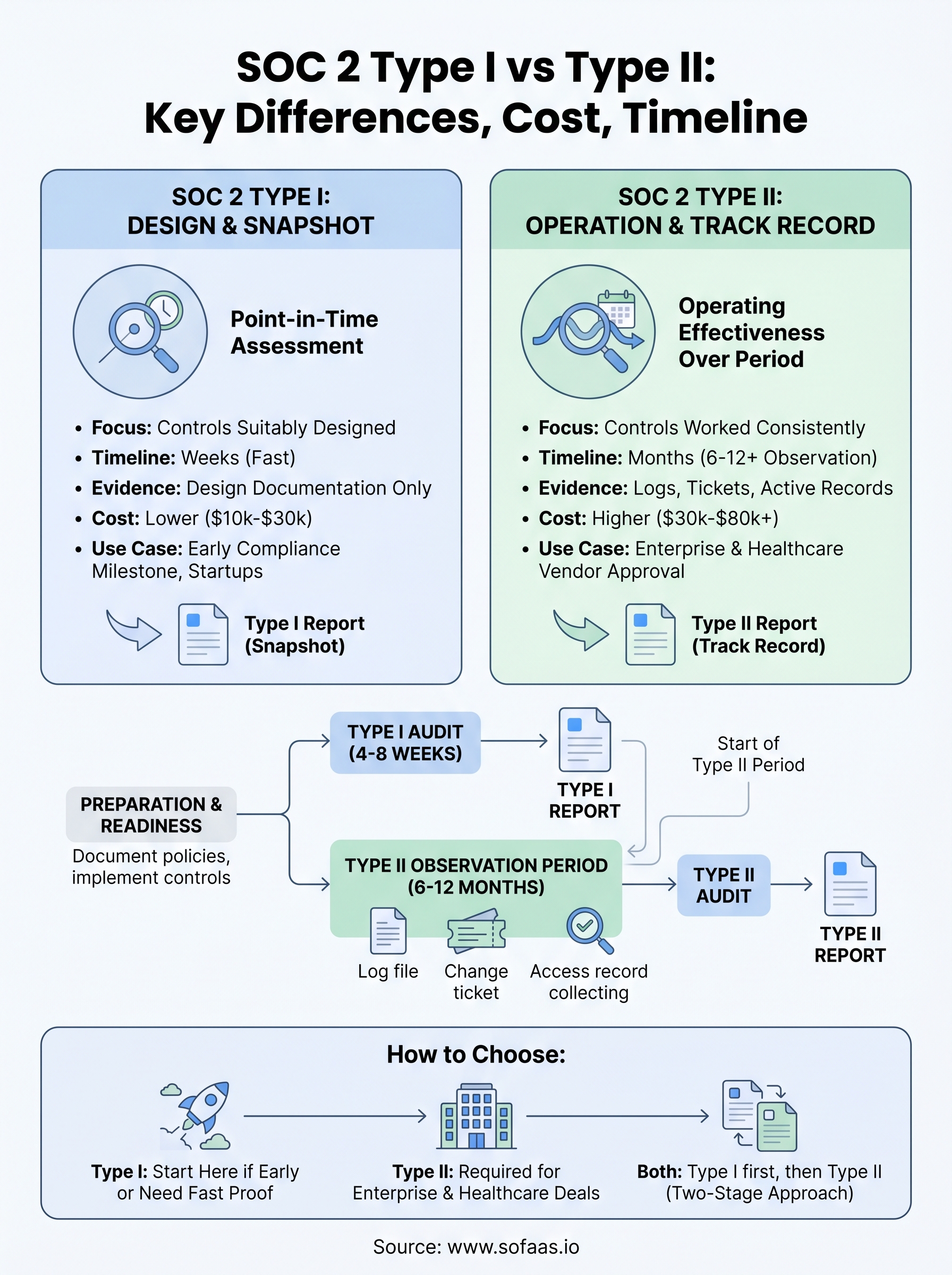
The core distinction in soc 2 type i vs type ii comes down to timing and proof. Both report types use the same Trust Services Criteria and require an independent CPA auditor, but they answer fundamentally different questions. Type I asks whether your security controls are designed correctly at a specific point in time. Type II asks whether those controls actually functioned as designed across a defined review period, typically six to twelve months.
Customers and enterprise procurement teams increasingly treat Type II as the baseline expectation, not the advanced option.
What a Type I report tells you
A Type I report captures a point-in-time assessment of your security controls. The auditor reviews your system description and evaluates whether your controls are suitably designed to meet the relevant Trust Services Criteria as of a specific date. The auditor is not testing whether those controls ran consistently or caught real issues; they're confirming that the controls exist and are logically built to address the risks you've documented.
This makes Type I a reasonable starting point if you're building your security program from scratch and need to demonstrate to early customers that you've invested in real controls. It moves faster than Type II, which makes it useful for teams under pressure to produce a compliance artifact before a specific deal or partnership deadline.
What a Type II report tells you
A Type II report covers operating effectiveness over a defined observation period. Your auditor isn't just reviewing what controls you have; they're testing whether those controls worked consistently during that window by examining evidence such as logs, access records, incident tickets, and change management documentation. The resulting report reflects how your security program actually performed, not just how it was designed.
For healthcare platforms and enterprise SaaS products, Type II carries significantly more weight in vendor reviews. A customer evaluating your platform wants confidence that your security controls held up under real conditions, across real transactions, over real time. That's what Type II delivers.
| SOC 2 Type I | SOC 2 Type II | |
|---|---|---|
| Assessment scope | Point-in-time design review | Operating effectiveness over a period |
| Observation window | Single date | Typically 6-12 months |
| Auditor testing | Control design only | Design and evidence-based testing |
| Customer confidence level | Moderate | High |
| Common use case | Early compliance milestone | Enterprise and healthcare vendor approval |
Timeline and evidence requirements
The timeline difference in soc 2 type i vs type ii is one of the most practical factors when you're deciding which report to pursue. Type I audits can wrap up in a matter of weeks once you have your controls documented and your auditor engaged. Type II audits require a defined observation period before the audit even begins, which means you're looking at a minimum of six months before you can produce a final report.

Type I timeline: what to expect
A Type I audit typically takes four to eight weeks from initial engagement to final report, assuming your documentation is in reasonable shape. Your auditor reviews your system description, interviews your team, and evaluates whether your controls are suitably designed as of a specific assessment date. There's no waiting period tied to evidence accumulation, which is why teams under deadline pressure often pursue Type I first.
The main variable that stretches a Type I timeline is documentation readiness. If you haven't formalized your security policies, access control procedures, or vendor management processes, expect to spend several weeks getting that material ready before your auditor can even start their review.
Type II timeline and the observation window
Type II audits require a minimum observation period of six months, though twelve months is the standard for reports that carry the most weight in enterprise procurement. Your auditor collects and tests evidence from across that entire window, so you need your controls running and generating consistent, retrievable records before the period begins.
Starting your observation window early is one of the most useful things you can do to avoid delays in your Type II audit.
Planning your full Type II timeline from initial readiness work through your final report typically runs nine to fifteen months, depending on how mature your security program is when you start.
What auditors actually look for
For Type II, the evidence your auditor tests goes well beyond written policies. They examine access logs, change management tickets, and incident response records to verify that controls ran as described throughout the observation period. Gaps in that evidence, even a few missing log entries or undocumented access reviews, can generate exceptions in your final report.
Your internal team needs to treat evidence collection as an ongoing operational task, not something you assemble at the last minute before your audit closes. Building that discipline into your day-to-day workflows is what separates a clean Type II report from one with findings.
Cost, effort, and what usually slows teams down
Understanding the cost difference in soc 2 type i vs type ii helps you plan realistically rather than getting caught off guard midway through the process. Both report types require a licensed CPA auditor, but Type II commands a higher price because it involves more auditor hours, deeper evidence testing, and a longer engagement window.
What Type I and Type II audits typically cost
Type I audit fees generally range from $10,000 to $30,000, depending on the scope of Trust Services Criteria you include and how much remediation work your auditor identifies during fieldwork. Organizations that enter the audit with clean documentation and well-organized policies tend to sit at the lower end of that range.
Type II fees typically run between $30,000 and $80,000 for most mid-sized SaaS or healthcare platforms, though complex environments with multiple systems and large headcounts can push costs higher. Beyond auditor fees, factor in the internal time your engineering, security, and operations teams will spend preparing evidence, responding to auditor requests, and fixing control gaps before your observation window closes.
The full cost of a Type II audit is rarely just the auditor's invoice. Internal preparation often represents more total hours than the audit fieldwork itself.
Where teams lose the most time
The most common bottleneck in both report types is documentation that no longer matches how your systems actually run. Policies written months earlier that don't reflect your current architecture force your team to either revise them quickly or explain discrepancies to your auditor, which adds time and creates risk of findings in your final report.
For Type II specifically, teams frequently underestimate the discipline required to collect and preserve evidence continuously throughout the observation period. Access reviews that happen quarterly but aren't logged properly, change tickets that close without adequate documentation, or vendor assessments that miss required frequency all generate exceptions. These aren't necessarily catastrophic findings, but they weaken the report's credibility with enterprise buyers who scrutinize those exceptions closely.
Remediation timing is another area where teams consistently fall behind. If your auditor identifies a control gap during Type I fieldwork and you plan to fix it before launching your Type II observation period, build in buffer time for that remediation to be tested and validated before your window opens. Rushing that work leads to gaps that carry into your first Type II evidence window and extend your overall compliance timeline beyond what you planned.
How to choose the right report type
The decision between soc 2 type i vs type ii is not just about compliance. It's about what your customers and partners actually require to approve you as a vendor. Start by looking at the deals you're trying to close and the procurement requirements in your pipeline. If enterprise buyers or healthcare organizations are asking for a SOC 2 report, find out specifically which type they expect before you commit to an audit path.
Start with Type I if you're early in your compliance journey
Type I makes sense when you need to demonstrate a mature security program quickly and you don't yet have six months of operational evidence to support a Type II observation window. Teams building their first formal compliance program often use Type I to satisfy an early partner requirement or a proof-of-concept contract while they run their controls and accumulate the evidence they'll need for Type II. It also gives your team a structured audit cycle to identify control gaps before they show up as exceptions in a more demanding Type II review.
If a customer will accept Type I today but plans to require Type II within twelve months, building toward Type II from day one saves you from doing the same remediation work twice.
Prioritize Type II when enterprise deals are on the table
Healthcare organizations, hospital systems, and enterprise procurement teams routinely require Type II as a non-negotiable condition of vendor approval. A Type I report may open early-stage conversations, but it often won't clear a full security review for contracts that involve protected health information or significant data volumes. If your sales cycle runs through procurement teams at large health plans or hospital systems, assume they want Type II and plan your timeline accordingly.
For SaaS platforms targeting multiple enterprise verticals, Type II also signals operational maturity in a way that Type I cannot match. Your customers aren't just buying your product; they're taking on vendor risk. A Type II report gives them auditor-tested evidence that your security controls held up under real conditions, which reduces their internal review burden and speeds up final approval.
When pursuing both makes sense
Some companies pursue Type I first and then Type II within the same year as a two-stage approach. This works well when you face near-term contract pressure but aren't yet ready to launch a six-month observation window. Confirm with your auditor upfront that your Type I assessment date can anchor into the start of your Type II observation period, so you avoid duplicating fieldwork unnecessarily and keep your overall compliance timeline as tight as possible.
Next steps
The soc 2 type i vs type ii decision comes down to one practical question: what does your pipeline actually require right now? If enterprise deals or healthcare vendor approvals are in front of you, start your Type II observation window as early as possible and treat evidence collection as a daily operational habit rather than a pre-audit scramble. If you need a near-term compliance milestone, pursue Type I first and build toward Type II as a structured follow-on.
Your audit path gets significantly easier when your underlying infrastructure is already built for compliance. Healthcare platforms that handle patient data need security controls that run continuously and generate clean evidence across access management, encryption, and availability. SoFaaS is designed with exactly that in mind, including SOC 2 Type II certified infrastructure so you can focus on your application instead of building compliance from scratch. See how SoFaaS handles healthcare integration compliance and cut months off your path to production.
The Future of Patient Logistics
Exploring the future of all things related to patient logistics, technology and how AI is going to re-shape the way we deliver care.
Thank you! Your submission has been received!
Oops! Something went wrong while submitting the form.