Zero Trust Architecture Definition: Principles And Pillars

Traditional network security operated on a simple assumption: everything inside the perimeter is safe. That assumption has proven dangerously wrong, especially in healthcare, where patient data moves between EHR systems, third-party applications, and cloud platforms every second. A clear zero trust architecture definition starts here, with the recognition that no user, device, or connection should be inherently trusted, regardless of where it sits on the network.
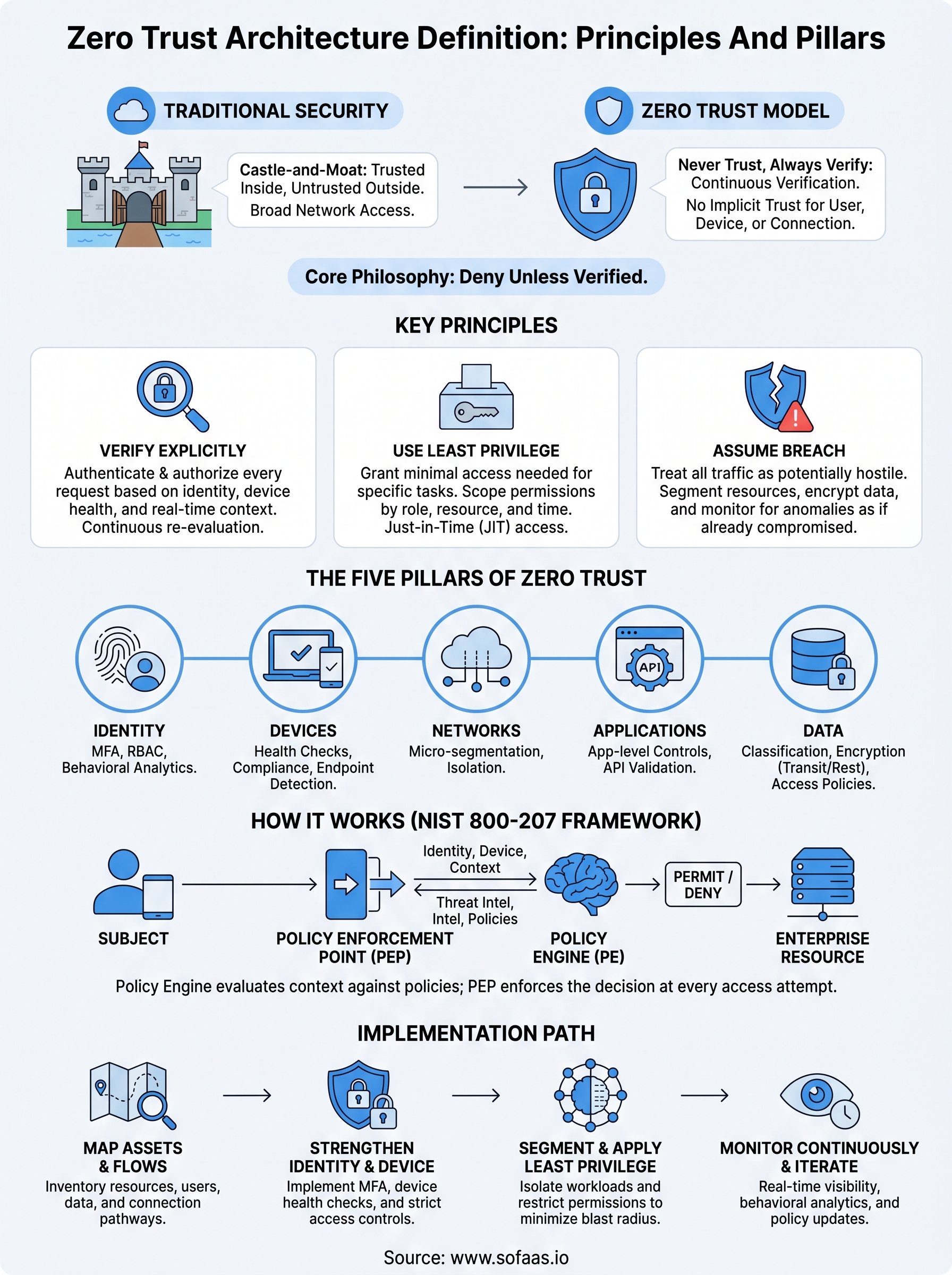
Zero Trust Architecture (ZTA) replaces the old castle-and-moat model with continuous verification at every access point. Its core principle, "never trust, always verify", is formalized in frameworks like NIST Special Publication 800-207, which lays out how organizations should design and implement these controls. For anyone building or managing systems that handle sensitive data, understanding ZTA isn't optional. It's foundational to real security.
At SoFaaS, we build managed infrastructure for SMART on FHIR integrations that connect healthcare applications to EHR systems like Epic, Cerner, and Allscripts. Security isn't a feature we bolt on, it's embedded in our SOC 2 Type II compliant, HIPAA-compliant architecture. Zero Trust principles directly inform how we handle OAuth authorization, token management, and patient data access controls across every connection.
This article breaks down what Zero Trust Architecture actually means, walks through its core principles and pillars, and explains the NIST framework that guides its implementation. Whether you're evaluating security models for a new healthcare application or strengthening an existing integration pipeline, this is the knowledge you need to make informed decisions.
Why zero trust matters in modern IT
The network perimeter that once defined enterprise security is no longer a reliable boundary. Remote work, cloud adoption, and third-party integrations have stretched corporate networks far beyond any single firewall's reach. When your users connect from home, your data lives in cloud environments, and your applications pull records from external systems, the concept of a "trusted inside" simply doesn't hold. Zero Trust Architecture directly addresses this reality by treating every access request as potentially hostile until verified otherwise.
The perimeter model failed
Security teams built their defenses around a clear boundary for decades. The assumption was straightforward: keep attackers out at the edge, and everything inside is safe to use freely. That model worked reasonably well when every employee sat at a desk inside a corporate building and every application ran on an on-premise server. Today, none of those conditions reliably apply to most organizations.
Cloud services, mobile devices, remote employees, and contractor access points have dissolved that perimeter. Attackers now know that breaching a single endpoint, credential, or third-party vendor gives them broad lateral movement across a network that still trusts its interior. The 2020 SolarWinds attack demonstrated exactly how devastating that assumption can be, with attackers moving quietly through trusted internal connections for months before detection.
Once an attacker is inside a perimeter-based network, the network itself becomes the attack surface.
Why modern threats demand continuous verification
Modern attacks rarely announce themselves at the front door. Credential theft, phishing campaigns, and supply chain compromises give attackers legitimate-looking identities that pass traditional perimeter checks without raising alarms. By the time your team detects unusual activity, sensitive data may already be exfiltrated or weaponized.
Continuous verification changes the equation entirely. Instead of checking identity once at login and then granting broad access, Zero Trust systems validate every request against current context, including device health, user behavior, geographic location, and the specific resource being requested. This approach dramatically shrinks the window an attacker has to operate before controls flag and block the activity. Your security posture stops relying on where a request originates and starts focusing on whether that request should be granted at all.
Why healthcare environments carry higher stakes
Healthcare organizations face a specific and severe version of this challenge. Patient records, authorization tokens, and clinical workflows cross between EHR platforms, third-party applications, and cloud services constantly. Each connection point is a potential exposure if access controls still rely on perimeter assumptions rather than verified, context-aware decisions.
The consequences of a healthcare data breach extend well beyond an incident response report. HIPAA violations carry civil penalties up to $1.9 million per violation category per year, and reputational damage can erode patient and provider trust for years afterward. Beyond compliance costs, operational disruption from a breach can delay care delivery in ways that carry real clinical risk.
When you work through a complete zero trust architecture definition, you quickly see that it is not about stacking additional security tools on top of existing infrastructure. It is about rebuilding the fundamental assumption that governs every access decision your systems make, from the first authentication request to every subsequent API call your application fires.
Zero trust basics: model, architecture, ZTNA
Before you can apply Zero Trust to your systems, you need to understand what each term actually refers to. "Zero Trust" started as a concept, became a model, and has since been built out into specific technical implementations. These layers connect, but they are not interchangeable, and conflating them leads to misaligned security strategies.
Zero trust model vs. zero trust architecture
The zero trust model is the underlying philosophy: no user, device, or network connection receives implicit trust. Every access request requires explicit verification, regardless of origin. This model was formalized by former Forrester analyst John Kindervag in 2010 and has since become the governing framework for modern enterprise security design.
Zero trust architecture is how you engineer your systems to enforce that model. A complete zero trust architecture definition includes the policies, controls, data flows, and technologies that ensure every resource request is authenticated, authorized, and continuously validated before access is granted. NIST 800-207 defines ZTA as an evolving set of cybersecurity paradigms that move defenses from static, network-based perimeters to focus on users, assets, and resources specifically.
Your architecture does not become zero trust by adding a new tool. It becomes zero trust when your default assumption changes from "allow unless blocked" to "deny unless verified."
What ZTNA adds to the picture
Zero Trust Network Access (ZTNA) is a specific technology category that implements zero trust principles for remote and application-level access. Where traditional VPNs grant broad network access after a single authentication step, ZTNA grants access only to the specific application or resource the user requests, and only after validating identity, device posture, and context in real time.
ZTNA is one component within a broader zero trust architecture, not a synonym for it. Your organization might deploy ZTNA for remote workforce access while separately enforcing zero trust controls for internal API calls, EHR data flows, and service-to-service authentication. Each layer serves a distinct function, and together they form the architecture that eliminates implicit trust across your entire environment.
Core principles that drive every decision
Any complete zero trust architecture definition rests on three foundational principles. These are not suggestions or best practices you layer on top of your existing security policy. They are the operating assumptions your entire architecture must reflect, from how users authenticate to how services call each other internally.
Verify explicitly, every time
Every access request in a zero trust system must be evaluated against current, real-time context, not a trusted baseline set at login. This means your systems check identity, device compliance, user location, requested resource sensitivity, and behavioral signals before granting access, and they do this for every request, not just the first one.
Implicit trust is a vulnerability. If your system trusts a session because it authenticated an hour ago, you have a gap an attacker can exploit.
This principle requires your organization to move away from static access grants. You should build dynamic policy enforcement that re-evaluates access continuously rather than relying on session state to carry permissions forward.
Use least privilege access
Least privilege means users and services receive only the access they need to complete a specific task, nothing more. You scope permissions tightly by role, resource, and time, and you remove access when it is no longer needed. This directly limits lateral movement if a credential is compromised, because a breached account with narrow permissions can do far less damage than one with broad, inherited rights.
Applying just-in-time (JIT) access takes this further by granting elevated permissions only for the duration of a specific task, then revoking them automatically. In healthcare integrations, this matters enormously because patient data access should be tied to an active clinical or operational need, not a standing permission set.
Assume breach at all times
Designing with the assumption that attackers are already inside your environment changes how you build every layer of your architecture. You segment resources, encrypt data in transit and at rest, monitor all traffic for anomalies, and design response playbooks before an incident occurs. This principle forces your security team to treat internal traffic with the same skepticism applied to external requests, eliminating the dangerous distinction between inside and outside your network.
The five pillars and key components
When you work through a complete zero trust architecture definition, you find that it organizes around five distinct pillars. Each pillar represents a control domain where you must apply verification, visibility, and least-privilege enforcement. Together, they form the structural foundation that makes zero trust operational rather than theoretical.

Identity
Identity is the first pillar and the foundation of every access decision in a zero trust system. You verify every user and service account through multi-factor authentication (MFA), role-based access controls, and real-time behavioral analytics before granting any resource access. If identity is compromised, every other control layer becomes your last line of defense, which is why you invest heavily here first.
A verified identity is not a trusted identity. Verification happens continuously, not once at login.
Devices
Your architecture must assess the health and compliance status of every device attempting access before it can connect to any resource. This means enforcing endpoint detection, checking OS patch levels, and validating device certificates in real time. A user with valid credentials on a compromised device still represents a threat that your controls need to catch.
Networks
Network segmentation isolates workloads and limits lateral movement across your environment. You divide your network into micro-segments with strict access policies between them, so a breach in one zone cannot propagate freely to others. This pillar directly dismantles the old assumption that internal traffic is inherently safe.
Applications
Application-level controls ensure that each service, API, and workflow is individually protected rather than exposed across a broadly trusted network zone. You apply access policies at the application layer, validate every API call, and restrict what each application can request from others. In healthcare integrations, this is where OAuth token scopes and SMART on FHIR authorization flows operate as zero trust enforcement mechanisms.
Data
Data is the ultimate target in any attack, which makes it the most critical pillar to protect. You classify data by sensitivity, encrypt it in transit and at rest, and enforce access policies based on who needs which data for which specific purpose. Visibility into data access patterns lets you detect anomalies before they escalate into breaches.
How zero trust works and maps to NIST 800-207
A complete zero trust architecture definition requires understanding not just the principles but the mechanics. Every access decision in a zero trust system flows through two core components: a policy engine that evaluates the request against current context and a policy enforcement point that either permits or blocks the connection based on that decision. These components work together in real time, processing signals from identity providers, device posture tools, and behavioral analytics before any user or service reaches a protected resource.
The policy engine and policy enforcement point
The policy engine (PE) is the decision-making brain of your zero trust system. It pulls in signals about the requesting identity, the device health score, the sensitivity of the resource, and current threat intelligence, then weighs them against your organization's access policies to produce a permit or deny outcome. The policy enforcement point (PEP) sits between the subject and the resource, acting on whatever the policy engine decides. No request bypasses the PEP, whether it originates from a remote employee, an internal service, or an API call between two application layers.

Your policy engine is only as effective as the signals feeding into it. Weak identity data or incomplete device telemetry produces unreliable access decisions regardless of how well your policies are written.
What NIST 800-207 specifies
NIST Special Publication 800-207 formalizes these mechanics into a concrete framework your team can use to design and audit zero trust implementations. The publication defines seven core tenets, including treating all data sources and computing services as resources, securing all communication regardless of network location, and granting resource access on a per-session basis rather than through persistent trust. These tenets translate the philosophical model directly into architectural requirements your engineers can build against.
NIST 800-207 also distinguishes between ideal zero trust deployments and practical migration paths for organizations still running legacy infrastructure. You are not expected to rebuild everything at once. The framework supports an incremental maturity model, allowing you to apply zero trust controls progressively, starting with your highest-risk access points and extending coverage as your architecture and team capabilities develop over time.
How to implement zero trust step by step
Applying a complete zero trust architecture definition to your real environment requires a structured sequence of steps, not a single tool purchase. You start by understanding what you have, then build controls progressively outward from your most critical assets. Each phase produces measurable improvements in your security posture before you move to the next.
Map your assets and access flows
Before you can enforce verification, you need a complete inventory of every resource, user, service account, and data flow in your environment. Document what data exists, where it lives, who accesses it, and through which pathways. This mapping exercise reveals your highest-risk access points and tells you exactly where to apply your first controls. Without it, you are building policy against an incomplete picture.
Strengthen identity and device controls
Your next priority is hardening the identity and device pillars across your environment. Deploy multi-factor authentication for every user account, enforce role-based access controls tied to specific job functions, and implement device compliance checks that run at every connection attempt. A compromised credential hitting a strict device health gate is far less likely to succeed than one hitting a broad, session-based trust grant.
Identity and device controls are your two highest-return investments early in a zero trust implementation because they address the most common attack vectors directly.
Segment your network and apply least privilege
Once identity and device controls are in place, you segment your network into micro-perimeters that isolate workloads from each other. Define access policies at the application and data layer so that each service can only reach the specific resources it needs to function. Revoke standing permissions and shift to just-in-time access grants wherever your workflows allow it. This step directly limits the blast radius of any credential or device that does get compromised.
Monitor continuously and iterate
Zero trust is not a one-time deployment. You need real-time visibility across every access event, behavioral anomaly detection, and a regular review cycle that tightens policies as your environment evolves. Build dashboards that surface unusual access patterns, run periodic audits against your asset inventory, and update your policy engine rules as new threats and new integrations emerge.
Key takeaways and next steps
Zero trust architecture starts with one foundational shift: no user, device, or connection receives implicit trust. The complete zero trust architecture definition that NIST 800-207 formalizes gives your team a concrete framework to build continuous verification, least-privilege access, and breach-assumption controls across every layer of your environment.
Your implementation path follows a clear sequence. Map your assets, harden identity and device controls, segment your network, and monitor access patterns continuously. Each step reduces your attack surface and limits the damage if any single credential or device is compromised.
Healthcare environments carry the highest stakes in this work. Patient data flows across EHR systems, third-party applications, and APIs constantly, and each connection is a potential exposure point. If you are building SMART on FHIR integrations that need security controls built in from day one, launch your SMART on FHIR app on SOC 2 compliant infrastructure and skip rebuilding the compliance stack yourself.
The Future of Patient Logistics
Exploring the future of all things related to patient logistics, technology and how AI is going to re-shape the way we deliver care.
Thank you! Your submission has been received!
Oops! Something went wrong while submitting the form.