HIPAA Compliance Definition: Rules & Requirements Explained

Every organization that handles protected health information (PHI) needs to understand one thing clearly: what HIPAA compliance actually requires. The HIPAA compliance definition goes beyond a simple checkbox exercise, it's a set of federal standards that govern how health data is stored, accessed, transmitted, and protected. Getting it wrong carries real consequences, from seven-figure fines to criminal charges.
Whether you're building a healthcare application, running a home health agency, or integrating with electronic health records (EHRs), HIPAA applies to you, or to the vendors and partners you work with. The rules cover two core areas: the Privacy Rule and the Security Rule, and they establish specific administrative, physical, and technical safeguards that covered entities and business associates must follow.
This article breaks down what HIPAA compliance means, walks through each major rule, and explains the requirements you need to meet. At SoFaaS, we build HIPAA-compliant, SOC 2 Type II infrastructure into our managed SMART on FHIR platform so healthcare innovators can integrate with EHRs without building compliance from scratch. That hands-on experience gives us a practical perspective on what these rules look like when applied to real healthcare data workflows, and we'll share that perspective throughout this guide.
HIPAA compliance definition and scope
The Health Insurance Portability and Accountability Act (HIPAA) was signed into federal law in 1996. At its core, the HIPAA compliance definition refers to an organization's ongoing adherence to the federal standards this law establishes for protecting sensitive patient health information. Compliance is not a one-time project or a certification you earn and forget. It is a continuous operational requirement that shapes how you collect, store, transmit, and handle health data across every system and workflow in your organization.
What HIPAA is and where it came from
Congress passed HIPAA primarily to address two problems: workers losing health insurance coverage between jobs, and the urgent need to standardize electronic health record exchange across the industry. As electronic systems became more widespread, regulators quickly realized that standardizing health data also introduced serious new risks around privacy and security. The Department of Health and Human Services (HHS) responded by issuing supplemental rules, including the Privacy Rule in 2000 and the Security Rule in 2003, which together form the operational core of what organizations must follow today.
The HHS Office for Civil Rights (OCR) holds enforcement authority and investigates complaints and breaches. Knowing this history helps you understand why HIPAA covers such a broad range of activities, from physical paper records sitting in a file cabinet to real-time patient data flowing through cloud-based EHR integrations. The law was intentionally designed to evolve alongside technology, so its requirements apply just as firmly to modern API-driven platforms as they do to older systems.
HIPAA compliance is not a certification you earn once. It is a set of ongoing practices your organization must maintain, demonstrate, and continuously improve.
The scope of HIPAA: who and what it covers
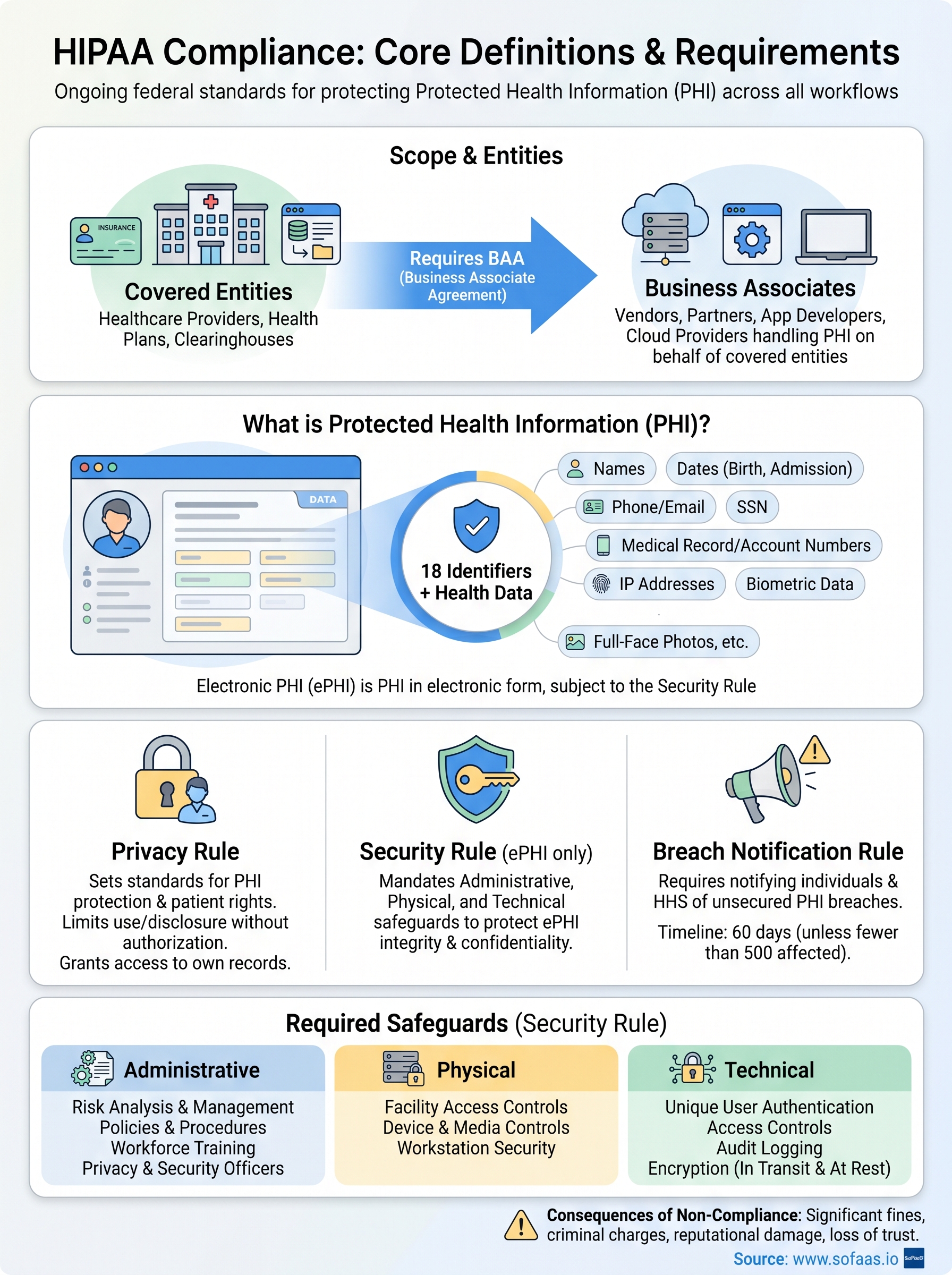
HIPAA applies to any organization that creates, receives, maintains, or transmits protected health information (PHI). The law divides organizations into two primary categories: covered entities and business associates. Covered entities include health plans, healthcare clearinghouses, and healthcare providers that transmit health information electronically. Business associates are the vendors, partners, and service providers, including software developers, cloud infrastructure providers, and integration platforms, that handle PHI on behalf of a covered entity.
The scope extends further than many technology teams initially expect. If you build a healthcare application that connects to an EHR and processes any patient data, your product almost certainly falls under HIPAA's reach, either directly or through a Business Associate Agreement (BAA) with the covered entity you serve. The law does not carve out exceptions for small companies, early-stage startups, or platforms that only handle data briefly during transmission. If PHI passes through your system, HIPAA follows it.
The key areas HIPAA governs
HIPAA compliance breaks into several distinct rule sets, each addressing a different dimension of health data protection. The Privacy Rule establishes patient rights over their health information and places strict limits on how that information can be used or disclosed without authorization. The Security Rule focuses specifically on electronic PHI (ePHI) and mandates administrative, physical, and technical safeguards to protect it from unauthorized access or disclosure. The Breach Notification Rule requires covered entities and business associates to notify affected individuals and HHS whenever a breach of unsecured PHI occurs.
Your organization needs to address all three rule sets at the same time rather than treating them as separate compliance tracks. A technically strong security program without proper privacy controls still leaves you exposed to violations and penalties. The framework is deliberately interconnected because real-world health data risks rarely fall into a single, cleanly defined category. Building compliance into your systems from the beginning is far more practical than retrofitting it after your product is already in production.
Why HIPAA compliance matters in healthcare tech
If you're building or operating in the healthcare technology space, understanding the HIPAA compliance definition isn't academic, it's operational. Healthcare data is among the most sensitive information that exists, and the systems you build or integrate with carry real liability when that data is mishandled. Non-compliance doesn't just put patient privacy at risk. It puts your business at risk.
Treating HIPAA compliance as a core product requirement from day one is far less costly than addressing violations after they occur.
The financial and legal consequences of non-compliance
The penalties for HIPAA violations are structured in four tiers based on the level of negligence involved. At the lowest tier, where an organization did not know and could not have known about a violation, fines start at $100 per violation and can reach $50,000. At the highest tier, willful neglect without correction, penalties reach $50,000 per violation with an annual cap of $1.9 million for repeated violations of the same type. On top of civil penalties, the Department of Justice can pursue criminal charges for intentional misuse of PHI, which carries prison sentences.
These numbers matter to you as a technology builder because violations often stem from infrastructure gaps and poorly designed workflows rather than intentional misconduct. A misconfigured API endpoint, an unencrypted data transfer, or a missing Business Associate Agreement can all trigger an investigation by the HHS Office for Civil Rights. The enforcement record shows that both large health systems and small vendors face penalties, so company size provides no protection.
How compliance shapes product development and trust
HIPAA compliance directly influences how you architect your systems and how your customers evaluate your product. Healthcare buyers, whether they are hospital systems, health plans, or EHR vendors, conduct rigorous vendor assessments before signing any contract. They will ask for evidence of your compliance posture, including policies, security controls, and BAA terms. If your product cannot demonstrate HIPAA-compliant infrastructure, you lose deals before they reach the technical evaluation stage.
Beyond sales, compliance shapes day-to-day engineering decisions throughout your product lifecycle. Every feature that touches patient data requires you to assess access controls, audit logging, encryption, and data retention. Building those controls into your platform from the start keeps your development cycles predictable and your data handling practices auditable, which is exactly what your healthcare partners need to see before they trust you with their patients' information.
What counts as PHI and ePHI
Any solid understanding of the HIPAA compliance definition requires knowing exactly what information the law protects. Not all health-related data triggers HIPAA requirements. The law draws a specific boundary around protected health information (PHI), which is any individually identifiable health information that a covered entity or business associate creates, receives, maintains, or transmits. If your application touches data that falls inside that boundary, HIPAA governs how you handle it.
The 18 identifiers that make data PHI
HHS defines PHI based on 18 specific identifiers. When any of these identifiers appears alongside health information, treatment data, or payment records, the combined data becomes PHI and falls under HIPAA's full protection requirements. You need to account for every one of these identifiers when you design your data collection, storage, and transmission workflows.

The 18 identifiers are:
- Names
- Geographic data smaller than a state (street address, city, ZIP code)
- Dates directly related to an individual (birth date, admission date, discharge date)
- Phone numbers
- Fax numbers
- Email addresses
- Social Security numbers
- Medical record numbers
- Health plan beneficiary numbers
- Account numbers
- Certificate or license numbers
- Vehicle identifiers and serial numbers
- Device identifiers and serial numbers
- Web URLs
- IP addresses
- Biometric identifiers (fingerprints, voice prints)
- Full-face photographs and comparable images
- Any other unique identifying number or code
If you remove all 18 identifiers from a data set, it qualifies as de-identified information under HIPAA and falls outside the law's privacy requirements. This de-identification process must follow strict standards to be legally recognized.
What makes ePHI different
Electronic PHI (ePHI) is simply PHI that exists in electronic form. This includes data stored in databases, transmitted through APIs, processed in cloud environments, or displayed within a web application. The Security Rule applies specifically to ePHI, which is why any platform that integrates with EHRs must implement technical safeguards on top of the privacy protections that apply to all PHI formats.
For healthcare technology teams, ePHI is the most operationally relevant category because your systems almost certainly create, receive, or transmit it. Patient records pulled from an EHR, lab results returned through an API call, and authorization tokens tied to a patient identity all involve ePHI. Every data flow in your system that touches patient-linked information needs to be mapped, documented, and protected to maintain a defensible compliance posture.
Who must comply: covered entities and business associates
The HIPAA compliance definition extends well beyond hospitals and insurance companies. Understanding exactly who the law applies to is the first step in determining your own obligations, and the rules reach further into the technology supply chain than most developers and product teams initially realize.
Covered entities: the primary regulated group
HIPAA identifies three types of covered entities that bear direct compliance responsibility under the law. The first type is healthcare providers, which includes any doctor, clinic, hospital, pharmacy, or home health agency that transmits health information electronically in connection with certain transactions. The second type is health plans, including insurers, HMOs, Medicare, and employer-sponsored health plans. The third type is healthcare clearinghouses, which process non-standard health data into standardized formats.
If your organization falls into any of these three categories, you carry the full weight of HIPAA compliance obligations regardless of your size or the volume of data you handle.
The practical test for healthcare providers is whether they transmit health information electronically for transactions such as claims, referrals, or eligibility checks. If they do, HIPAA applies automatically. For health plans and clearinghouses, the designation is typically straightforward based on the organization's primary business function.
Business associates and the BAA requirement
A business associate is any vendor, contractor, or service provider that creates, receives, maintains, or transmits PHI on behalf of a covered entity. This category covers a wide range of organizations in the healthcare technology space, including cloud infrastructure providers, software developers, EHR integration platforms, billing services, and data analytics companies. If your product handles PHI while serving a covered entity, you are a business associate and HIPAA applies to you directly.

The formal mechanism that establishes this relationship is a Business Associate Agreement (BAA), a required contract between the covered entity and the business associate that specifies each party's responsibilities for protecting PHI. Without a signed BAA in place, neither party is operating within the law's requirements. Healthcare buyers routinely request your BAA terms early in the sales process, so having a clear and well-structured agreement ready accelerates your deals.
Business associates also pass compliance obligations downstream to their own subcontractors. If you use a third-party cloud provider, data processor, or integration tool that touches PHI as part of your service, you must execute BAAs with those vendors as well. That chain of agreements is what gives the regulatory framework its reach across the entire healthcare data supply chain.
The main HIPAA rules you need to know
A complete HIPAA compliance definition covers several distinct regulatory rules that work together to protect patient data. Each rule targets a different aspect of how health information is handled, and you need to understand all of them to assess your obligations accurately. Ignoring any single rule while meeting the others still leaves significant compliance gaps in your organization.
The Privacy Rule
The Privacy Rule sets the national standard for protecting PHI in all forms, whether paper, electronic, or oral. It gives patients specific rights over their health information, including the right to access their records, request corrections, and control how their data gets used or disclosed. Your organization must establish clear policies that limit PHI use to treatment, payment, and healthcare operations unless you obtain explicit patient authorization for other purposes.
The Privacy Rule also requires covered entities to provide patients with a Notice of Privacy Practices, a written document explaining how their health information is used and what rights they hold.
The Security Rule
The Security Rule focuses exclusively on ePHI and mandates that your organization implement three categories of safeguards: administrative, physical, and technical. Administrative safeguards include workforce training and designated security officer responsibilities. Physical safeguards govern facility access and workstation controls. Technical safeguards require access controls, audit controls, integrity mechanisms, and transmission security for all systems that store or transfer ePHI.
Unlike the Privacy Rule, the Security Rule applies a flexibility standard. You must implement safeguards that are reasonable and appropriate given your organization's size, technical capabilities, and risk profile. That flexibility does not reduce your obligation; it means you must document your risk analysis and justify every implementation decision you make.
The Breach Notification Rule
The Breach Notification Rule defines what happens when PHI is compromised. If your organization experiences a breach of unsecured PHI, you must notify affected individuals within 60 days of discovering the breach. Covered entities must also report breaches affecting 500 or more individuals to the HHS Office for Civil Rights and notify prominent media outlets in the affected states.
Business associates must notify the covered entity without unreasonable delay and no later than 60 days after discovery. Breaches affecting fewer than 500 individuals are logged and submitted to HHS annually. Tracking your breach response timelines and maintaining clear documentation of every incident keeps your organization within these required boundaries.
Core HIPAA compliance requirements and safeguards
The full HIPAA compliance definition includes specific, mandatory safeguards that your organization must implement to protect ePHI. These requirements are not optional suggestions. HHS structures them across three categories, each targeting a distinct layer of your security posture, and all three must be addressed simultaneously for your compliance program to hold up under an audit or investigation.
Administrative safeguards
Administrative safeguards form the policy and procedural backbone of your HIPAA program. You must designate a Privacy Officer and a Security Officer, conduct a thorough risk analysis to identify vulnerabilities in every system that touches ePHI, and implement a risk management plan to address those vulnerabilities. Your workforce also needs documented training on HIPAA policies, and you need procedures that limit PHI access to only the staff who require it for their job functions.
Key administrative safeguard requirements include:
- Documented security risk analysis and risk management process
- Assigned security and privacy officer roles
- Workforce training and access management policies
- Sanctions policy for employees who violate HIPAA rules
- Contingency planning for data backup and disaster recovery
Skipping or underdocumenting your risk analysis is one of the most common reasons HHS issues corrective action plans during compliance investigations.
Physical safeguards
Physical safeguards govern access to the facilities and devices where ePHI is stored or processed. You must control who enters your data centers, server rooms, and workstations. Workstation use policies and device disposal procedures are both required, which means you cannot simply discard old laptops or storage media without first ensuring the data they contain has been securely wiped.
Cloud-based healthcare platforms do not eliminate physical safeguard obligations. Your infrastructure provider manages the hardware layer, but you still need to document that your vendor controls meet HIPAA's physical requirements, typically through a BAA that specifies those responsibilities.
Technical safeguards
Technical safeguards cover the tools and controls you build directly into your systems to protect ePHI. You must implement unique user authentication so every person accessing patient data does so through an individually traceable identity, not a shared login. Automatic logoff, encryption of data in transit and at rest, and audit logging that records who accessed what data and when are all mandatory.
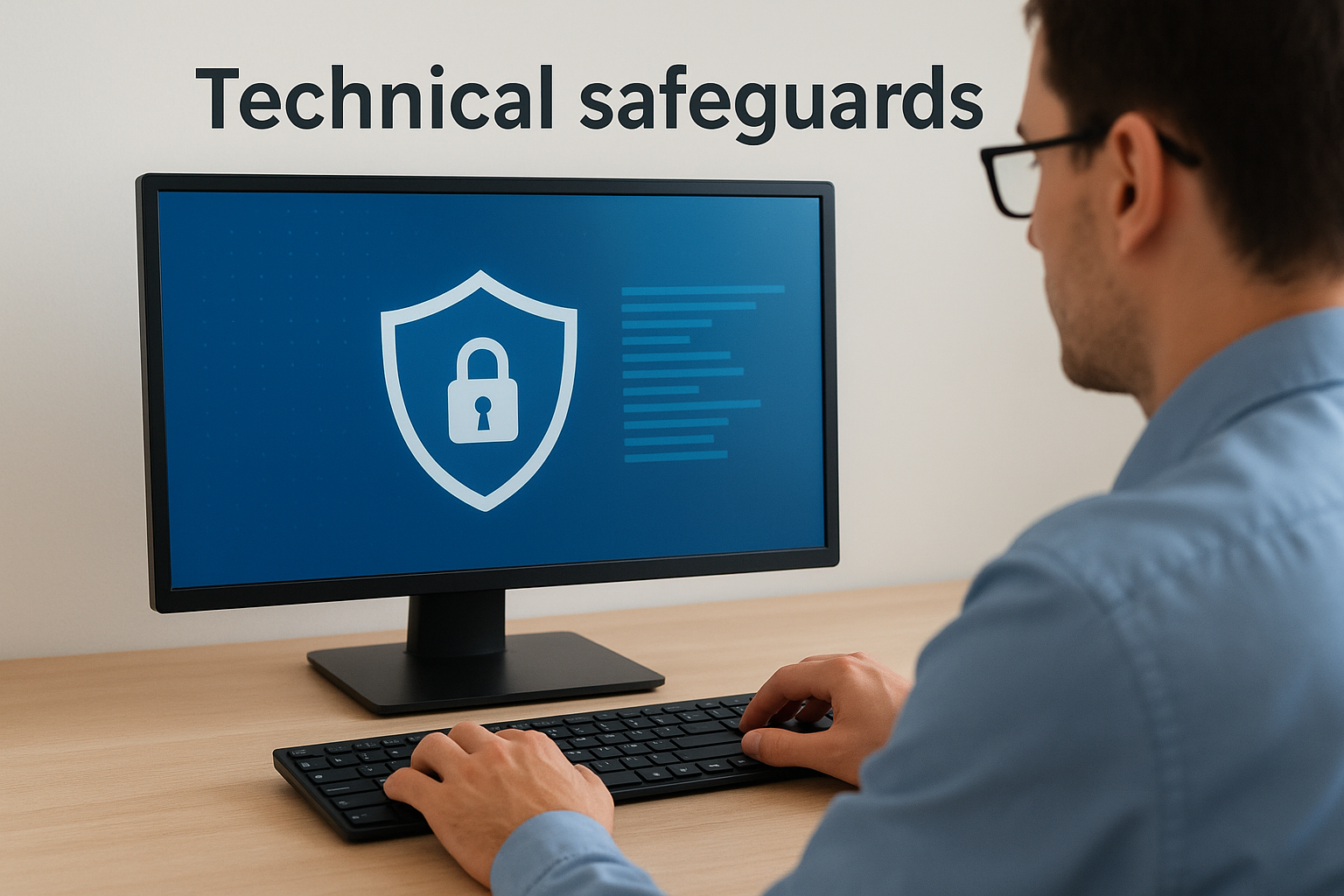
Your audit logs need to be tamper-resistant and retained long enough to support any investigation. Building these controls into your platform architecture from the start keeps your compliance posture defensible without requiring expensive rework later.
How to become HIPAA compliant step by step
Putting the HIPAA compliance definition into practice requires a structured, sequential approach rather than a scattered checklist. The steps below give you a clear path to follow whether you are building a new healthcare application or auditing an existing system. Each step builds on the previous one, so skipping ahead creates gaps that are difficult and costly to address later.
Map your data and identify PHI
Your first step is understanding exactly where patient data lives in your systems. Conduct a thorough data mapping exercise that traces every point where PHI enters, moves through, or exits your environment. This includes database tables, API payloads, log files, backup systems, and any third-party services your platform calls. Document each data flow explicitly so you have a complete inventory before you evaluate any risks.
Without this map, every subsequent step in your compliance program is built on incomplete information. You cannot protect data you have not located, and you cannot assign proper controls to workflows you have not documented in full.
Conduct a formal risk analysis
HHS requires you to perform a documented risk analysis that identifies threats and vulnerabilities across every system that touches ePHI. Evaluate the likelihood and potential impact of each identified risk, then prioritize your remediation efforts based on those results. Your risk analysis must be a written, revisable deliverable rather than an informal internal review.
A documented, up-to-date risk analysis is the first item HHS investigators examine during a HIPAA audit. Organizations that lack one face immediate corrective action regardless of how strong their other controls appear.
Implement safeguards and document your policies
Once you know your risks, apply the administrative, physical, and technical safeguards the Security Rule requires. Assign your Privacy Officer and Security Officer roles, establish access controls tied to individual user identities, enable encryption for all ePHI in transit and at rest, and activate audit logging across your systems. Write and distribute workforce policies that specify acceptable use, breach response procedures, and sanction rules for violations.
Execute BAAs and train your workforce
Sign Business Associate Agreements with every vendor that handles PHI as part of your service, and require the same from your subcontractors. Once your agreements are in place, train every employee who accesses PHI on your documented policies. Training is not a one-time event. Repeat it annually and keep completion records so you can demonstrate a consistent, ongoing compliance program to any auditor or healthcare partner who asks.
What to do next
The HIPAA compliance definition covers a broad framework, but the path forward is clear once you understand what each rule requires and where your systems currently stand. Start with your data map and risk analysis, since those two deliverables drive every safeguard decision that follows. Every step in this guide connects to a real, enforceable obligation your organization carries, so treat each one as a priority rather than a future project.
Building healthcare applications that connect to EHRs adds compliance complexity that can take months to address without the right foundation. SoFaaS provides HIPAA-compliant, SOC 2 Type II infrastructure built directly into a managed SMART on FHIR platform, so your team integrates with major EHR systems without building compliance architecture from scratch. Your organization handles patient data workflows while the platform handles the security and regulatory controls underneath. Launch your SMART on FHIR app and start connecting to EHRs in days, not months.
The Future of Patient Logistics
Exploring the future of all things related to patient logistics, technology and how AI is going to re-shape the way we deliver care.
Thank you! Your submission has been received!
Oops! Something went wrong while submitting the form.