What Is Dynamic Client Registration? OAuth/OIDC DCR Explained

Every time a healthcare application connects to an EHR's authorization server, it needs to be registered as an OAuth client first. Traditionally, that means logging into a developer portal, filling out forms, copying client credentials, and repeating the whole process for every EHR system you want to support. If you've ever wondered what is dynamic client registration, the short answer is: it's the protocol that lets applications register themselves programmatically, eliminating that manual bottleneck entirely.
Dynamic Client Registration (DCR) is defined in RFC 7591 and extended by OpenID Connect to allow OAuth 2.0 clients to obtain credentials from an authorization server at runtime, no admin portal clicks, no back-and-forth emails, no waiting. For teams building healthcare applications that need to integrate with Epic, Cerner, or other EHR platforms, DCR is increasingly relevant because SMART on FHIR workflows often depend on it for scalable, automated app registration across multiple health systems.
This is exactly the kind of complexity that SoFaaS™ abstracts away. Our managed platform handles OAuth and authorization management, including client registration flows, so you can connect to EHRs in days rather than spending months wrestling with protocol-level details. In this article, we'll break down how DCR works, where it fits within OAuth 2.0 and OpenID Connect, what the registration request and response look like, and why it matters for healthcare integration at scale.
Why dynamic client registration exists
To understand why DCR matters, you need to picture how OAuth client registration worked before it existed. Every application that wanted to use an OAuth 2.0 authorization server had to be manually registered by a human administrator. That person would create the client record, assign a client ID and secret, configure redirect URIs, and hand the credentials back to the developer. This process worked reasonably well when you had one or two integrations to manage, but it breaks down quickly in any environment where the number of clients grows or changes on a regular basis.
The manual registration bottleneck
Static, manual registration forces a human to be in the loop every time a new client application needs access to a protected resource. In practice, that means opening a ticket, waiting for approval, receiving credentials through some side channel, and then configuring your application manually. When you multiply that process across dozens of EHR systems, each with its own developer portal and its own registration workflow, you end up spending more time on administration than on building your actual product. The operational overhead alone is enough to delay product launches by weeks, sometimes months, and it scales poorly as your integration footprint grows.
Manual registration was never designed to scale. It was designed for an era when connecting a handful of trusted applications was the norm, not hundreds of them across fragmented systems.
When static credentials become a security liability
Beyond the time cost, static registration introduces credential management risk that compounds as you scale. Every client secret your team manually creates needs to be stored securely, rotated on a schedule, and revoked immediately if it leaks. When a healthcare application connects to multiple EHRs, you can end up managing a sprawling set of static client credentials, each one a potential attack surface. Rotating those credentials typically requires another round of manual portal interactions, which means teams often avoid doing it as frequently as security best practices require, leaving credentials in place far longer than they should be.
Why multi-tenant and multi-system deployments push things further
The credential management problem gets sharper when you consider modern multi-tenant architectures. If your application serves multiple healthcare organizations, each with different EHR environments, you may need a distinct client registration for each combination of tenant and authorization server. Doing that by hand is not just slow, it is practically unmanageable at any meaningful scale. A product team trying to onboard ten new hospital clients in a quarter cannot afford to open forty manual registration tickets and track each set of credentials through a spreadsheet. Automation at registration time is the only approach that keeps pace with real business growth.
The case for programmatic registration
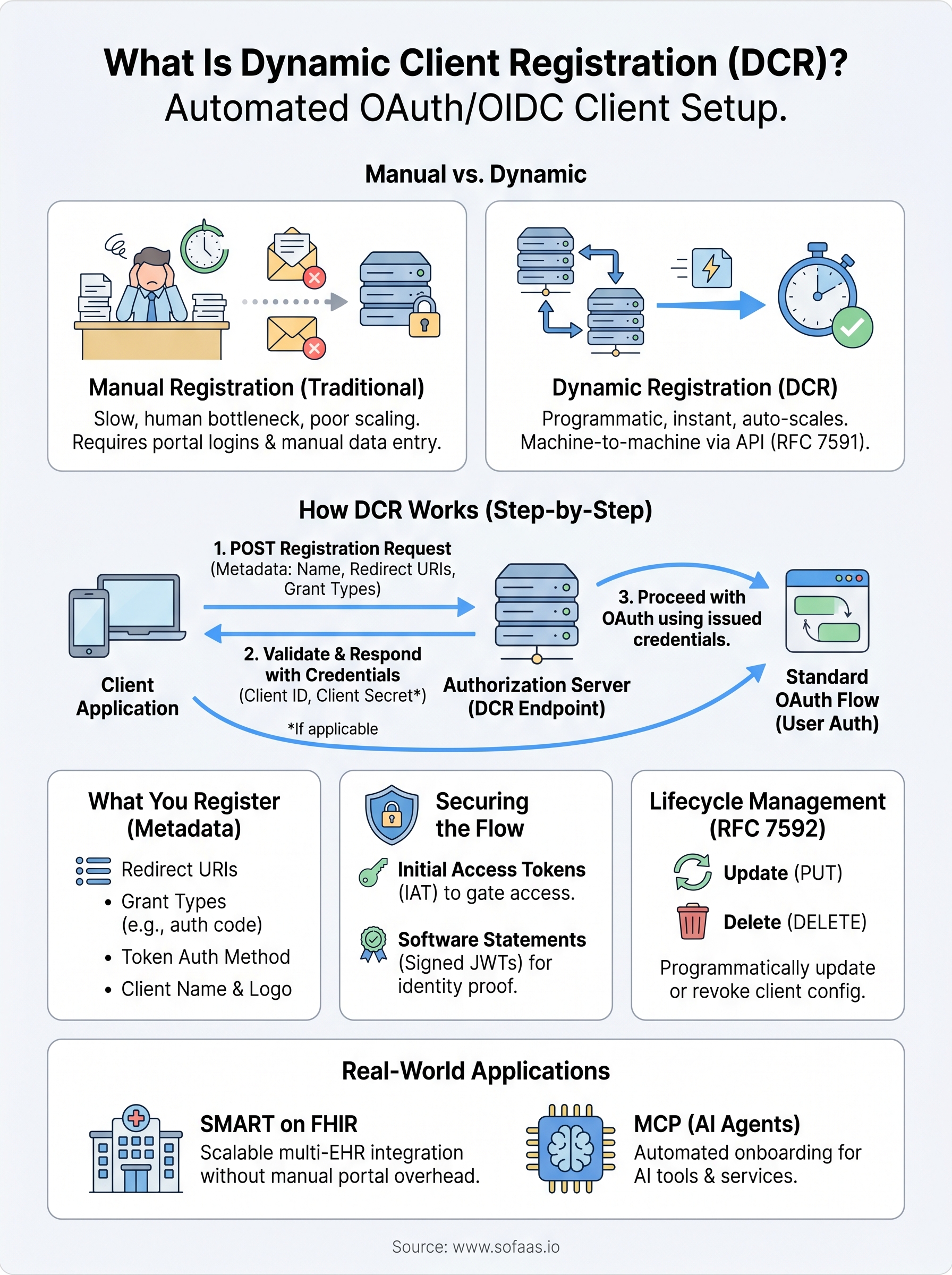
This is exactly the problem that what is dynamic client registration solves at the protocol level. Instead of requiring a human to pre-configure each client, DCR defines a standardized registration endpoint that your application can call directly. You send a POST request containing your application's metadata, and the authorization server responds with a client ID, a client secret when applicable, and any additional configuration needed to authenticate your application going forward. The entire exchange is machine-to-machine, removing the human bottleneck from the process entirely.
For healthcare specifically, this matters because the SMART on FHIR ecosystem involves many independent health systems, each running its own authorization server. Your application can send the same structured registration request to each server, receive its credentials, and proceed with the OAuth flow without anyone on either side manually reviewing a form. That shift from human-gated to API-driven registration is what makes multi-EHR integrations operationally practical rather than a constant source of coordination overhead.
How dynamic client registration works step by step
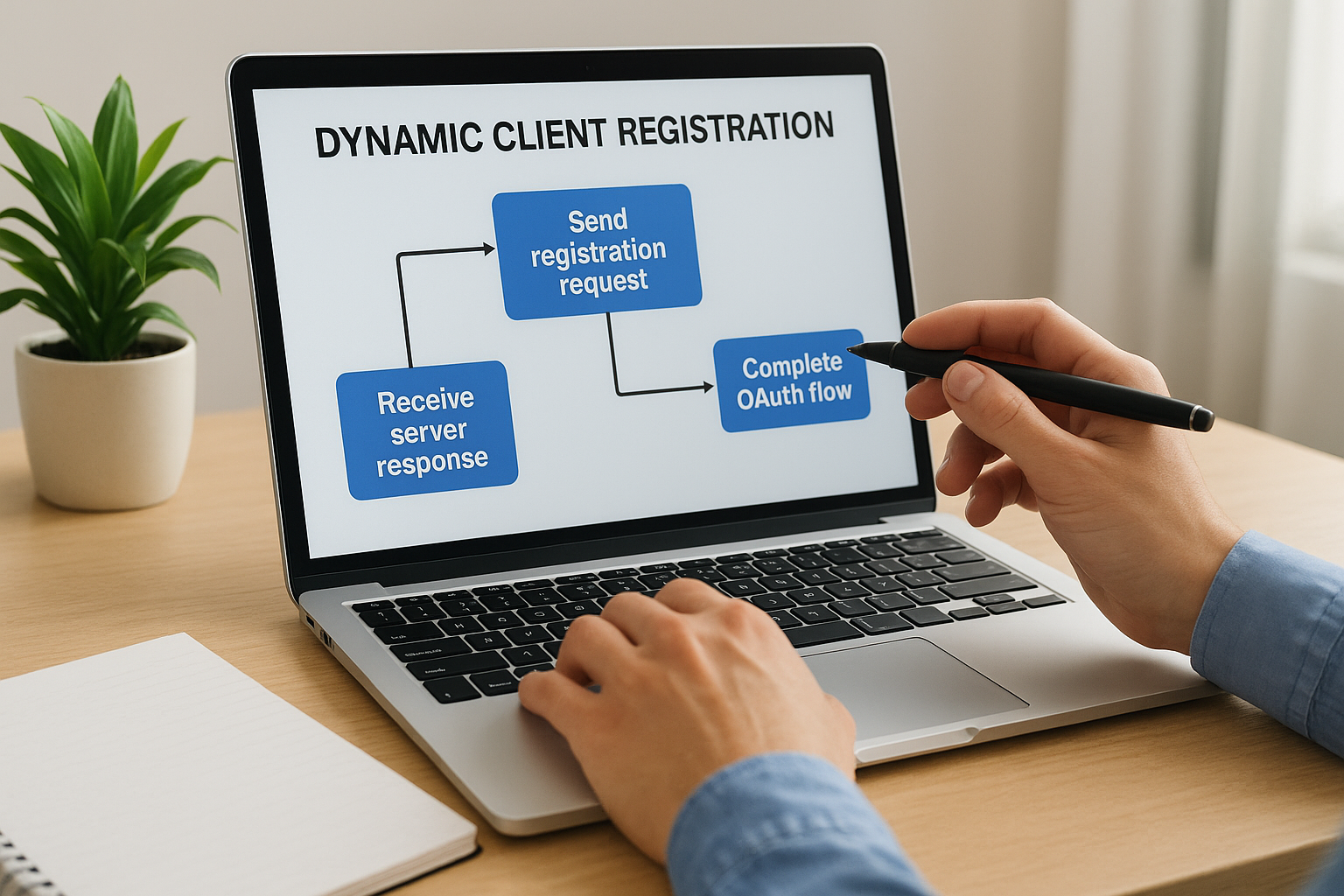
The mechanics behind what is dynamic client registration follow a consistent pattern defined in RFC 7591. Your application contacts a registration endpoint on the authorization server, submits a structured payload describing itself, and receives credentials in return. The whole exchange happens over HTTPS and requires no human on the other side to approve or configure anything manually.
Sending the registration request
Your application starts by sending a POST request to the registration endpoint, which the authorization server exposes specifically for this purpose. The request body contains a JSON object describing your client: things like your application name, the redirect URIs you plan to use, the grant types you need, and any token endpoint authentication method you support. Some authorization servers require an initial access token in the Authorization header to gate who can register clients at all, while others allow open registration for trusted environments.
Getting the metadata payload right matters more than most teams expect. Authorization servers validate each field strictly, and a mismatched redirect URI or unsupported grant type will cause the request to fail before any credentials are issued.
Receiving and storing the server response
If your request is valid, the authorization server responds with a client ID and, depending on the flow, a client secret. The response also echoes back the metadata the server accepted, which may differ slightly from what you submitted if the server normalized any values. Your application needs to store these credentials securely at this point, treating them the same way you would treat any sensitive credential, because you will use them to authenticate in every subsequent OAuth interaction with that server.
Completing the OAuth flow with registered credentials
Once you hold a valid client ID, your application proceeds through the standard OAuth 2.0 or OIDC authorization flow exactly as it would with statically registered credentials. You redirect the user to the authorization endpoint, include your client ID in the request parameters, and handle the callback at one of the redirect URIs you registered. The authorization server recognizes your client because it already has the registration record it created when your POST request succeeded, so the rest of the flow runs identically to any other OAuth exchange.
What you can register: client metadata and rules
The registration request you send to an authorization server is not a freeform document. RFC 7591 defines a specific set of client metadata fields that the server expects, and understanding which fields apply to your use case determines whether your registration succeeds or gets rejected outright.
Core metadata fields your application submits
The most consequential fields in a registration request are the ones that define how your application behaves during the OAuth flow. Your redirect_uris array tells the server exactly where it should send authorization codes after the user authenticates. The grant_types field declares which OAuth flows you intend to use, such as authorization_code for user-facing applications or client_credentials for server-to-server exchanges. The token_endpoint_auth_method specifies how your application authenticates when exchanging codes for tokens, with options ranging from client_secret_basic to private_key_jwt for environments where stronger authentication is required.
Mismatching your declared grant types with your token endpoint auth method is one of the most common reasons registration requests fail in SMART on FHIR environments, and the error messages are not always obvious.
Additional fields that shape authorization behavior
Beyond the core flow fields, you can also submit metadata that influences how the server presents your application to users during consent screens. The client_name, logo_uri, and client_uri fields give the server information to display when asking a patient or provider to authorize access. The scope field lets you declare the set of permissions your application needs upfront, though the server may grant only a subset of what you request depending on its own access policy and the sensitivity of the data involved.
Rules the server applies during registration
Understanding what is dynamic client registration also means recognizing that the server does not accept every value you submit without scrutiny. Authorization servers validate metadata strictly. They reject redirect URIs that use non-HTTPS schemes outside of localhost, refuse unsupported grant types, and normalize fields like scope to match what their configuration allows. Some servers enforce software statement requirements, where your request must include a signed JWT from a trusted authority attesting to your application's identity. In healthcare contexts, SMART on FHIR authorization servers commonly require this extra verification step to confirm that registering applications meet the health system's vetting standards before any credentials are issued.
How to secure dynamic client registration
Dynamic client registration opens your authorization server to programmatic requests, which makes the registration endpoint itself a surface that needs careful protection. Open endpoints that accept registrations from any caller create real risk: an attacker could register a malicious client, obtain valid credentials, and use them in phishing flows that look legitimate to users. Understanding what is dynamic client registration also means understanding the controls you put in front of it, because the protocol's flexibility only works in your favor when you implement the right safeguards from the start.

Gating access with initial access tokens
The most direct way to restrict who can register clients is to require an initial access token (IAT) in the Authorization header of every registration request. Your authorization server issues these tokens through a separate, controlled process, such as a developer portal, an admin approval workflow, or a server-side provisioning API. Only callers with a valid IAT can reach the registration endpoint and receive credentials, which means you retain control over who gets to register without reintroducing the full manual process that DCR was designed to eliminate.
Your team should also set short expiration windows on initial access tokens and scope them to single-use where your authorization server supports it. A token that expires quickly and cannot be reused limits the window an attacker has if one is intercepted or leaked during the provisioning process.
Validating software statements
In higher-assurance environments, initial access tokens alone may not be sufficient. Software statements give you a second layer of verification by requiring the registration request to include a signed JWT from a trusted third party, such as a regulatory body or a known intermediary, that attests to your application's identity and purpose. The authorization server validates the signature and claims in that JWT before it even evaluates the rest of the registration payload.
Software statements are mandatory in many SMART on FHIR deployments because health systems need provable assurance that a registering application has already passed vetting before it can access patient data.
Enforcing least-privilege on registered clients
After registration succeeds, your server should apply scope and grant type restrictions that match each client's declared purpose rather than issuing broad permissions by default. A client that registers for read-only data access should never be able to request write scopes later without a separate, audited approval step. Keeping registered clients scoped tightly limits the blast radius if credentials are compromised and makes audit logs significantly easier to interpret during incident response.
DCR in deployments like SMART on FHIR and MCP
Dynamic client registration is not just a theoretical protocol feature. It appears as a required or strongly recommended mechanism in several real-world deployment specifications, where the scale and security demands of the environment make manual registration genuinely unworkable. Two of the most relevant examples for healthcare technology teams are SMART on FHIR and the Model Context Protocol (MCP), both of which rely on DCR to handle app registration in environments that involve many independent authorization servers or frequently changing client configurations.

SMART on FHIR relies on DCR for multi-EHR scale
SMART on FHIR defines how third-party applications authenticate against EHR systems using OAuth 2.0. When your application needs to connect to multiple health systems simultaneously, each one runs its own authorization server with its own registration requirements. Without DCR, your team would need to manually register your application at every individual health system portal, collect credentials separately, and maintain each registration by hand. Understanding what is dynamic client registration in this context means recognizing that it is the mechanism that makes multi-EHR deployment operationally realistic rather than an administrative burden.
SMART on FHIR's endorsement of DCR is a direct response to the fragmented nature of the EHR market, where no single authorization server governs access across all health systems.
SMART on FHIR authorization servers that implement DCR accept your registration request, validate your software statement or initial access token, and return credentials your application can use immediately within that system's OAuth flow. Your application repeats this process for each health system it targets, using the same structured payload each time, which means your integration logic stays consistent even as the number of connected systems grows.
MCP uses dynamic registration to onboard AI tool clients
The Model Context Protocol defines how AI agents and large language model tools interact with external data sources and services. Because MCP clients can be spun up programmatically and need access to protected resources without a human manually configuring each one, the protocol incorporates OAuth 2.0 DCR as its mechanism for client onboarding. Your MCP-compatible tool sends a registration request to the authorization server protecting the target resource, receives credentials, and proceeds through the OAuth flow without any manual provisioning step involved. This makes DCR a foundational piece of any MCP deployment where clients are created and discarded dynamically rather than registered once and maintained indefinitely.
DCR management and lifecycle with RFC 7592
Registering a client is only the beginning. Once your application holds credentials from an authorization server, those credentials age, your application's requirements change, and sometimes you need to decommission a client entirely. RFC 7592 extends what RFC 7591 started by defining a client configuration endpoint that your application can use to read, update, or delete its own registration after the initial exchange. Understanding what is dynamic client registration in full means understanding this lifecycle layer, not just the moment credentials are first issued.
RFC 7592 gives your application the same programmatic control over its own registration that RFC 7591 gave it over creating one in the first place, which is what makes truly automated credential management possible.
Updating client metadata after registration
Your application's needs will shift over time. You may add new redirect URIs when you launch a feature, change your token endpoint authentication method when your security requirements tighten, or update your client_name and logo_uri when your product rebrands. RFC 7592 handles this through a PUT request to the client configuration endpoint, where you submit a complete updated metadata object and the server replaces the existing record. You must include the registration access token the server issued alongside your client ID during initial registration, because that token is what proves you own the registration you are trying to modify.
Each update request must carry the full set of client metadata you want in effect after the change. The server does not apply partial patches, so omitting a field from the payload means that field gets cleared on the server side. Your application should always read the current registration state before submitting an update to avoid accidentally removing settings your OAuth flow depends on.
Revoking and deleting client registrations
When you need to retire a client, RFC 7592 provides a DELETE request to the same client configuration endpoint. Sending that request with a valid registration access token removes the client record from the authorization server immediately, which means any tokens previously issued to that client will stop being accepted at protected resource endpoints. This gives you a clean, auditable way to decommission integrations when a customer offboards, a deployment is decommissioned, or a credential is believed to be compromised. Treating deletion as a first-class operation in your lifecycle automation, rather than leaving orphaned registrations in place, keeps your authorization server tidy and your attack surface smaller.
Next steps
You now have a complete picture of what is dynamic client registration: a protocol that replaces manual, human-gated OAuth client setup with a structured, machine-to-machine exchange that scales with your actual integration needs. From the initial RFC 7591 registration request through RFC 7592 lifecycle management, every step has a defined standard your application can implement and automate without waiting on developer portals or admin approvals.
Putting DCR into practice inside a SMART on FHIR environment still requires a solid foundation of OAuth handling, HIPAA-compliant infrastructure, and EHR-specific configuration knowledge. That is exactly where SoFaaS™ removes the burden. Rather than building and maintaining all of that yourself, you can launch your SMART on FHIR app through VectorCare's managed platform and connect to major EHR systems in days. Your team keeps its focus on the product, while the integration complexity stays handled.
The Future of Patient Logistics
Exploring the future of all things related to patient logistics, technology and how AI is going to re-shape the way we deliver care.
Thank you! Your submission has been received!
Oops! Something went wrong while submitting the form.